Thursday, January 12, 2012

NEA Jazz Master Jack DeJohnette in dual Blue Note Celebration


Story and photos by Dwight Casimere

-Dwight Casimere (l) with NEA Jazz Master Jack DeJohnette, the two were classmates at Englewood High School on Chicago's South Side

-Jack DeJohnette and sextet at the Blue Note

-Trumpeter Ambrose Akinmusire leads the finale on "Sonny Light"

-A work by Willem de Kooning


New York—Grammy Award-winning jazz drummer Jack DeJohnette has a lot to celebrate as he embarks on the New Year of 2012. On this night, at the Blue Note, he’s the object of a 70th Birthday Celebration. He is also being honored in a concert at Jazz at Lincoln Center commemorating his being awarded the 2012 National Endowment for the Arts (NEA) Jazz Master Fellowship, the highest honor for any jazz musician.

“I guess I’ll be celebrating all year,” he told me post performance. “Unfortunately, my good friend Von Freeman (a fellow Chicagoan, who is 82 years young) is ill and can’t be here with me.” Fellow jazz veterans Sheila Jordan, Charlie Haden and Jimmy Owens will be on hand to help ring in the ‘year of Jack DeJohnette’ in grand jazz style at the Rose Theatre concert.

The NEA award is just the formal recognition of a career resume that speaks volumes; he was a significant component of the original Charles Lloyd Quartet and Miles Davis’s landmark fusion bands and albums of the ‘60s and ‘70s. He, in fact, joined Davis’s group in 1968, just in time for the groundbreaking album Bitches Brew. He’s a frequent collaborator with pianist Keith Jarrett. Tonight, he’s fronting his own Sextet, playing original compositions from his new CD, Sound Travels. Tonight’s performance is a prelude to what audiences will be hearing at the Newport and Monterey Jazz Festivals and on his European tour later this year.

Jack DeJohnette does with drumsticks what the artist Willem de Kooning did with paint brushes, creating vivid images composed of bold swatches of heightened tonal color and lyrical lines that morph across diverse cultural landscapes and disparate musical formats.

Tonight’s aggregate is very international in nature, and reflects the musical eclecticism of its leader. Each is an established composer in his own right and has his own share of accolades and honors to his credit. The depth and intensity of their collective performance provided a rare window into the inner workings of the creative process. Saxophonist Rudresh Mahanthappa, is of Indian descent, but was born in Trieste, Italy and raised in Boulder, Colorado. He is a Guggenheim Fellow and 2011 Downbeat International Critics Poll Alto Saxophonist of the Year whose music incorporates the fusion of South Asian and traditional jazz influences. Dave “Fuze” Fiuczynski is an iconoclastic and prolific American jazz-fusion guitarist, hailed by the world press for his inventive approach. On this occasion, he is playing the two-necked guitar. “The top one is a fretless keyboard,” he explained to me, “much like a violin. It allows me to slide up and down between the notes as they do in Middle Eastern music. It creates a sound not unlike what you might here in the market square in Marrakesh. Jack heard me playing at a wedding recently, and I was doing a lot of Mediterranean-type music. He approached me and said he wanted me here on the gig because, ‘that’s the music I’ve been hearing in my head. (Paraphrasing Jack) We’ve got to do that at the Blue Note!’”

Venezuelan Percussionist Luisito Quintero in regarded as one of the hottest timbaleros in New York’s tightly knit Latin music fraternity. Having heard him on two successive nights, accompanying Richard Bona’s Mandekan Cubano project at the Jazz Standard and then again at tonight’s Blue Note engagement with DeJohnette, the word on his fiery facility with Afro-Venezuelan rhythms has obviously gotten around.

Bass guitar Jerome Harris has won international acclaim for his penetrating and versatile style. Besides being a fluid bassist, he has also distinguished himself as a guitarist. His hauntingly plaintively vocals add a highly emotive subtext. “Salsa For Luisito” provided not only a workout for Quintero’s considerable Afro-Latin chops, but a vehicle for Harris’s expansive vocals.

Saxophonist Tim Ries embodies the words “fusion” and “crossover.” He has performed and toured extensively with The Rolling Stones. In, his latest CD is Stones World/The Rolling Stones Project II. Ries has written more than 100 compositions in both the jazz and classical idioms. His Verve release with the Joe Henderson Big Band won a Grammy Award. His blazing soprano sax solos, particularly on the Sound Travels cut, Tango Africain, made the case for his considerable prowess.

Among the standout moments of the evening, Alto sax solos by Rudresh Mahanthappa on One for Eric, in honor of reed shooting star Eric Dolphy and Soulful Ballad, DeJohnette’s “talking timpani” on Tango Africain and keyboardist George Colligan, and his intense, liquid melodic explorations.

Fireworks emanated from the finale, Sonny Light, a tribute to Sonny Rollins, who Jack and other NEA Masters played for at his recent coronation at the Kennedy Center Honors. “Sonny just lights up a room and brings joy,” DeJohnette said before launching into the tune. It was an explosive romp in the Sunny Isles of the Caribbean, with guest trumpeter Ambrose Akinmusire. A native of Oakland, California, he is the winner of the 2007 Thelonius Monk International Jazz Competition and the Carmine Caruso International Jazz Trumpet Solo Competition, two of the most prestigious jazz competitions in the world, makes him one of the hottest young trumpeters on the current jazz scene. His fiery intensity was reminiscent of a young Hugh Masekela combined with the sophisticated chops of a Dizzy Gillespie. This was truly a memorable evening of Modern Jazz at its best.

Jack DeJohnette was born in Chicago in 1942. The Blue Note engagement provide an opportunity for a happy reunion for this reviewer, who attended Englewood High School on the South Side of Chicago with a then aspiring pianist, who had dreams of leading his own band in New York City. From all accounts, it’s a dream fulfilled and beyond anyone’s wildest imagination!

Saturday, January 7, 2012

Wynton Marsalis : The Music of Jelly Roll Morton & King Oliver


Wynton Marsalis: The Music of Jelly Roll Morton & King Oliver

Story and photos by Dwight Casimere

-JALC Artistic Director Wynton Marsalis with Dwight Casimere

-Master Drummer Yacub Addy (r)

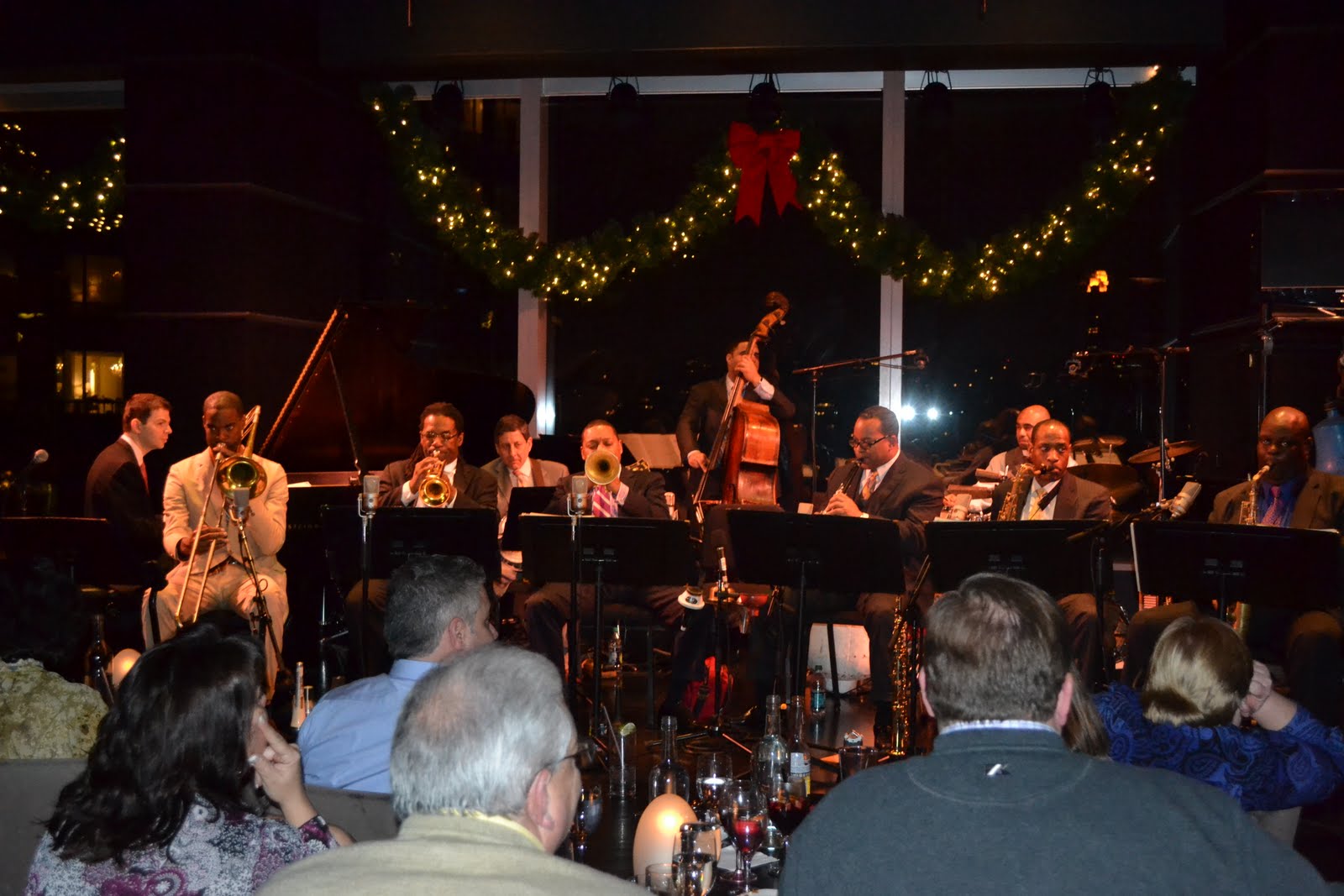
-JALC Orchestra at Dizzy's Club Coca Cola


New York—“All jazz is modern,” Wynton Marsalis, Artistic Director, Jazz at Lincoln Center declared, before embarking on an exploration of the music of Jelly Roll Morton and King Oliver at Dizzy’s Club Coca Cola. The concerts were carried in live video stream on the internet and on local National Public Radio stations around the country.

Marsalis’s New Year’s Eve weekend concerts served as a vehicle to explore the music of nearly a century ago, in order, he explained, to better understand the music of today. “When you listen to this music, you realize that this is the source. This is where it all comes from.” With that, Marsalis and his Lincoln Center Jazz Orchestra launched into King Oliver’s “Dipper Mouth Blues,” which Marsalis later said was named in honor of Oliver’s second trumpet, a then-newcomer by the name of Louis Armstrong. "In the early days, before he became Satchmo, his nickname was Dipper Mouth.” Besides Marsalis’s searing trumpet solos, clarinetist Victor Goines ignited the solo passages of this up-tempo, bright homage to the greatest jazz trumpeter of the last century, Armstrong, as played by the greatest jazz trumpeter of this century, Marsalis.

Trumpeter Marcus Printup and Tenor sax Walter Blanding then proceeded to raise the roof on Jelly Roll Morton’s New Orleans Bump. Afterwards, Morton’s Dead Man Blues started with the elegiac ring of a cowbell and a short dialogue from the band members, which bemused the passing of a stranger. Spearheaded by Ricky “Dirty Red” Gordon on washboard and percussion, the orchestra then launched into a funeral dirge accented by Chris Crenshaw, the youngest member of the band, on trombone. Dueling clarinets from reedists Victor Goines and Walter Blanding, with extended solos by Ali Jackson on drums and James Chirillo on banjo and Carlos Henriquez on bass, brought home the exquisite nature of the point, counterpoint, almost fugue-like character of early jazz.

“The thing you’ll notice about this music,” Marsalis later explained, “is that sometimes, everybody plays at once. At times, it sounds like they’re almost fighting!” Victor Goines' elongated notes and prolonged passages created an excitement that really kicked the entire proceeding up a notch. “They used to call Jelly Roll the ‘Bard of New Orleans,” Marsalis explained. Dead Man Blues demonstrated why.

Pianist Dan Nimmer, with his encyclopedic keyboard knowledge, moved effortlessly between the stride piano percussiveness of yesteryear to the McCoy Tyner-tinged aggressiveness of the avant-garde.

The most exquisite moments of the evening occurred when Marsalis himself launched into extended trumpet solos. Early jazz seems to bring out the best in him. He not only plays from his soul, he reaches into the imprint of his DNA to reveal the music that spawned his musical genius. Perhaps the most revealing moments came at the end of the concert, when African Master Drummer Yacub Addy joined Marsalis and the orchestra. The collaboration further demonstrated the cultural roots and timeless expression of music that is as relevant today as it was at its inception nearly a hundred years ago.

Upcoming engagements at Dizzy’s Club Coca Cola include MLK Celebration with Warren Wolf Quintet Jan 16, The Music of Max Roach with Willie Jones III Sextet Jan 17-22 and Victor Goines leading his own Quintet Jan 31. For information, visit jalc.org/dccc.

New Year's Eve 2011, a celebration with many faces


The many faces of New Year’s Eve

Story and photos by Dwight Casimere

New York Harbor photos by Meghan Hart

-The Luxury Yacht Manhattan at Chelsea Pier

-Fireworks over New York Harbor

-The balloon drop at midnight, the Waldorf=Astoria, Happy New Year 2012!

-New Year’s Eve revelers at the Starlight Roof

New York---From watching fireworks near the Statue of Liberty from an historically influenced yacht, to observing the famed Waterford Crystal ball drop in a freezing Times Square to the balloon drop in the Starlight Roof of the venerable Waldorf=Astoria hotel, New Year’s Eve 2011 was a cornucopia of sights, sounds and experiences.

When the 1920s-styled luxury yacht Manhattan powered from Chelsea Pier into New York Harbor to witness the ‘rockets red glare’ around the Statue of Liberty, it was just the start of an historic New Year’s Eve celebration. Operated by Classic Harbor Line, the 1920s style, mahogany-trimmed “commuter” yacht offers a unique weekend cruise that encircles the entire island of Manhattan, passing under its bridges and stopping at the Statue of Liberty. Simultaneously, the countdown was beginning at Times Square, where a million people braved the arctic cold to await the timed ball drop at One Times Square.

The iconic Starlight Roof at the famed Waldorf=Astoria hotel on Park Avenue was the scene of one of the nation’s most revered traditions, the hotel's annual New Year’s Eve Gala. Past generations delighted in the live national televised broadcast of Guy Lombardo and The Royal Canadians and their annual New Year’s Eve show from 1960 to 1978. This year’s New Year’s Eve Gala 2011 was a celebration of R & B, Pop, Soul and Big Band Era hits with a live orchestra and a brilliant vocal ensemble. They played and sang while large screen television monitors kept revelers abreast of the ball-drop activities in Times Square with Dick Clark and Ryan Seacrest.

The Waldorf=Astoria’s Executive Chef and his brilliant team provided a sumptuous banquet at the Starlight Roof. Beginning with an Amuse Bouche of Ginger Crusted Tuna with Glass Noodles and Pickled Scallions, the seamless wait-staff guided diners through an exceptional four-course dinner that was highlighted by the superb Entrees of perfectly prepared Rack of Lamb Persillade, with Candied Eggplant, Potato Ecresse and Melted Leeks or Grilled Tournedo of Beef (Prime Aged Filet Mignon), cooked to perfection with a Saffron Mussel Risotto, Fennel, Tomato and a Mediterranean influenced Bouillabaisse Sauce.

Perrier Jouet Champagne Grand Brut ($39) flowed throughout the evening, leading to a celebratory toast and the much-anticipated balloon drop from the Art Deco panels of the Starlight Roof.

A Champagne Toast punctuated the night. The toasty, polished texture of the Perrier Jouet added to the festive nature of the evening and brought out the subtle flavors of the cuisine with its hints of Golden Delicious apple, brioche pastry and spiced orange peel. As Dick Clark’s New Year’s Rockin’ Eve with Ryan Seacrest 2012 completed the countdown, the simultaneous festive balloon at the Starlight Roof and the descent of the Crystal Ball in Times Square marked the start of what promises to be a spectacular 2012!

Wednesday, December 28, 2011

Broadway In Chicago: The Addams Family up to old wicked post-Holiday tricks


Entertainment

Broadway In Chicago: The Addams Family

By Dwight Casimere

Photo courtesy Broadway In Chicago

The Addams family onstage at the Cadillac Palace Theatre, Chicago

While you’re out and about in the Loop, returning unwanted Christmas gifts, making exchanges and scooping up the myriad bargains, you might want to take a side trip to he Cadillac Palace Theatre on West Randolph and drop into the macabre world of The Addams Family. The weird, yet enchanting musical continues there for this weekend only, through January 1st. If you want to ring in the New Year on a bizarre note, this is the place to do it.

Hi-jinks kick off almost immediately when a disembodied curtain tassel scurries across the stage and the blood red curtain opens and the Company, in the guise of ashen graveyard denizens embark on a lively, high-stepping musical description of the plot scenario in “When You’re and Addams.” If you’re familiar with the multiple TV shows, movies or the original cartoon series by humorist and cartoonist Charles Addams for the New Yorker magazine, then you’re aware of the whacky events that will unfold. A scene change reveals the family patriarch Gomez Addams (an elegant, silver-voiced Douglas Sills) pondering his fate as the husband of Morticia (the sultry, darkly humorous Sara Gettelfinger) as he ponders the Byzantine ins and outs of his marriage in the humorous musical soliloquy “Trapped.”

By happenstance, the plot turns on an almost identical scenario as Broadway In Chicago’s La Cage Aux Folle, running concurrently at the Bank of America Theatre. In both musicals, a young adult offspring from an unorthodox family situation, plans to get married to someone outside their offbeat ‘culture.’ In La Cage, the parents are a gay male couple, in The Addams Family, they’re ghouls. In both cases, the offspring tries to convince the parents to masquerade as ‘normal’ for just one night, when they bring their fiancĂ©’s parents home for dinner. In both musicals, the ensuing events are uproarious!

Patricia D. Kennedy is golden-voiced and beguiling as the plucky, rebellious daughter Wednesday, who is determined to get married a gushing Lucas Beineke (the valiant Brian Justin Crum). The one-liners and double entendres hinging on the macabre are gut-splitting. Some of the best lines are delivered by Uncle Fester (a disarming Blake Hammond) and Grandma (Pippa Pearthree). Victoria Huston-Elem uses her super-sonic voice and over-reaching physical comedy to deliver a scene-stealing number in the family ‘game’ scene, “Full Disclosure” during the comically disastrous family dinner at the end of Act One.

Sets & Costumes designed by Julian Crouch and Phelim McDermott do an effective job of conveying the dark, off beat world of the Addams family. The lively orchestra of local musicians Steve Leinheiser and Sean McNeely on Reeds, Andy Baker, Trumpet, Joe Sonnefeldt, percussion, Steve Roberts on Guitars, Scott Rosenthal, Bass and Steve Wnkler, Violin and Jocelyn Davis-Beck Cello, keeps the frantic action moving under the able conducting of Valerie Gebert. The Music & Lyrics and Arrangements by Andrew Lippa gives them plenty of lush material to work with.

Choreography by Sergio Trujillo and the superb dancing by the Company make this a visually stunning production.

The Addams Family makes the Kardashians seem like the Cleavers! There are only a few days left to catch all the blood-curdling shenanigans of the Addams clan. Visit wwww.BroadwayInChicago.com for show times.

Thursday, December 22, 2011

La Cage Aux Folles a polished Broadway in Chicago gem


Broadway In Chicago La Cage Aux Folles:

“I Am What I Am,” A Polished Broadway Gem

Story by Dwight Casimere

Photos by Paul Kolnikstud for Broadway In Chicago

-George Hamilton as Georges with “Les Cagelles”

-George Hamilton (Georges) and Christopher Sieber (Albin) in the finale

Broadway in Chicago’s current production of La Cage Aux Folles has the look and feel of a polished Broadway show, and with good reason. The majority of the cast are veterans of at least one of its several Broadway incarnations, including one of its stars, Christopher Sieber, who plays the centerpiece character, Albin, the self-described “one transvestite homosexual,” who provides the dramatic fulcrum for the musical. Indeed, it is Sieber, in the person of Albin, who delivers the show-stopping anthem, “I Am What I Am” at the end of Act 1, which serves as the emotional heartbeat of La Cage Aux Folles, at Chicago’s Bank of America Theatre, through Jan. 1, 2012.

La Cage aux Folles is the only Broadway musical that has won the Tony Award for Best Revival of a Musical twice, and the only show that has won a Best Production Tony Award (Best Musical or Best Revival of a Musical) for each of its Broadway productions.

Christopher Sieber starred in La Cage on Broadway as the character Georges, who is played in Chicago by the venerable actor George Hamilton.

A 50 -year veteran of film and television, Hamilton, is a living monument to his profession. He plays Albin’s “male” partner, with dignity and aplomb. In addition to his encyclopedic film and television credits, he has distinguished himself on Broadway, playing the starring role of Billy Flynn three times in the smash hit Chicago. There are key moments in La Cage that offer a window into the inner genius of his skills as a performer. Hamilton employs a dramatic pause in several scenes that allows his character’s ‘voice’ to speak volumes. He achieves in silence, an eloquence equal to the words of Harvey Fierstein’s often poignant script.

Georges (Hamilton) is the proprietor of the French Riviera nightclub of the title, which is the setting for the racy transvestite revue that stars his life-partner, Albin (Sieber). The two have raised a son, Jean-Michel (Billy Harrigan Tighe), whom Georges sired in a drunken one-night stand with a chorus girl at the Lido in Paris, where Georges once starred. Georges and Albin’s sequin-covered world is suddenly rent asunder when Jean-Michel announces that he is about to be married and wants to bring his fiancĂ©, Anne (an ebullient Doris-Day-ish Allison Blair McDowell) and her arch-conservative parents, the Dindons (an irascible Bernard Burak Sheredy and a comically inept Cathy Newman) home.

M. Dindon is a right-wing politician, running for office on a platform based on his crusade against the libertine elements that run rampant in the south of France. His avowed mission is to eradicate transvestite clubs and their ilk from the face of the earth. With a substantial dowry at risk, Jean-Michel wants Albin gone from the premises, so that he can bring the girl’s parents into a seemingly ‘normal’ home. (Albin later delivers one of the great, standout lines of the entire evening, when he tongue-in-cheek (pardon the pun) mangles Dindon’s name, calling him “Ding-dong.”)

Albin, who raised Jean-Michel, is understandably crushed. Hamilton reprimands his son and shames him through the moving song “Look Over There.”

Georges attempts to smooth things over with Albin over a rare lunch at an outdoor cafĂ© on the Promenade, and sings the lovely “Song on the Sand.” It’s hard not to hear the great Gene Barry’s voice in the back of your mind on that one, but Hamilton comports himself ably. Although his voice wavers at time, he sings with conviction and delivers the lyric with authority. He’s a master at ‘selling’ a song, as evidenced in the comic scene that incorporates the song, “Masculinity,” in which Georges attempts to teach the effeminate Albin to adopt the mannerisms and ungainly walk of John Wayne, with hilarious results!

The club’s male chorus dancers, “Les Cagelles” are a consistent delight throughout the performance. We hear them singing, in cabaret cadence, “I Am What I Am, and what I Am is an illusion,” although we can see the pecs and biceps under all the pasties and sequins and a distinct “package” under the g-strings. Their athleticism particularly comes into focus in the “Birdcage” dance that opens the second act. Jeigh Madjus as the “butler (maid)” Jacob is a sassy bundle of comic energy throughout.

If you’ve tired of the marathon of Holiday treacle and commercialism, La Cage Aux Folles is a welcome tonic, which treats a sensitive subject with humanity and humor. It gives the Holiday chestnut “Peace on Earth, Goodwill toward Men” a deeper and more universal meaning.

Sunday, December 18, 2011

Robert Joffrey's Nutcracker celebrates 25 years of Holiday Magic


Joffrey Ballet an annual Holiday delight

By Dwight Casimere

Photo by Herbert Migdoll

Robert Joffrey’s The Nutcracker, now underway at Chicago’s Auditorium Theatre through December 27, is the quintessential incarnation of the renowned Holiday staple, now celebrating 25 years. What sets it apart from the other myriad productions around the Chicagoland area, indeed, around the country, is the company’s meticulous attention to detail. Every eleve, pirouette, plie and arabesque is a monument to perfection, thanks to the leadership of Artistic Director Ashley Wheater, a Royal Ballet alum, hand-picked to helm the Joffrey by its co-founder, Gerald Arpino, in 2007. Under Wheater’s direction, he has brought in world-class choreographers to create new full-length works for the company and has worked diligently to hone the already exceptional skills of the company’s superlative dancers. The results, as evidenced by a recent performance of The Nutcracker, are nothing short of astonishing.

Robert Joffrey and Co-Founder Gerald Arpino set out to create a different kind of Nutcracker from the very beginning, jettisoning the traditional Victorian European setting and replacing it with a nostalgia-laden 19th century American one. The set was populated with toys and costumes that might be familiar to many from old family portraits. Today’s production retains the original choreography, costumes and sets, including the beloved giant Mother Ginger puppet by Kermit Love. An intermission interlude of Christmas Carols sung by the British School of Chicago Choir was the icing on the cake. If there are any little one’s (or even some big ones) in the family who have yet to experience this Holiday treasure, there are a handful of performances left to experience this wonder unfolding. Visit joffrey.org or ticketmaster.com for show times.

Tuesday, December 13, 2011

Met Live HD: Gounod’s Faust a “Magnificent ride”


Met Live HD: Gounod’s Faust a “Magnificent ride”

By Dwight Casimere

Photos: Ken Howard/Metropolitan Opera

-Marina Poplavskaya as Marguerite

-Jonas Kaufmann as Faust

-Rene Pape as Mephistopheles

-Faust and Mephistopheles dress to the nines before sealing their deal

-A fallen Valentin (Russell Braun) is comforted by Marguerite (Marina Poplavskaya)


A “magnificent ride!” is how two-time Tony Award Director Des McAnuff described his Metropolitan Opera production of Gounod’s Faust, seen by audiences in movie theatres worldwide in Met Live HD. McAnuff, winner of the Tony Award for Best Director of a Musical in 1985 for The Big River and again in 1993 for The Who’s Tommy and who was nominated for Jersey Boys in 2006 (which won the Tony Award for Best Musical that same year), and conductor Yannick Nezet-Sequin, helmed a stellar cast of actor/singers, led by the charismatic German tenor Jonas Kaufmann, Musical America’s 2011 Vocalist of the Year, in the title role and Dresden doll beauty, Russian soprano Marina Poplavskaya as the idealized object of his headlong affection, Marguerite. Seguin revealed to backstage host, Met soprano Joyce DiDonato, that he would be driving to Philadelphia immediately after that afternoon’s performance to conduct the Philadelphia Orchestra, where he is Music Director Designate, taking up the full title of Music Director in the New Year.

McAnuff, in his Met Debut, takes the story from its original setting of the ancient world of author Johann Wolfgang von Goethe, and updates it to the Atomic Age of 1945. The sparse sets and military garb (brilliant costumes by Paul Tazewell) of the Met Opera Chorus and dancers (who are an intricate part of this superlative production, under Chorus Master Donald Polumbo), with striking use of looming video segments, provide the stark backdrop for the gripping action onstage. Large, full-faced portraits of the principles alternate with gigantic red roses and Georgia O’Keefe clouds to create a moving video subtext to the melodramatic story of Faust’s descent into moral bankruptcy as a result of his deal-with-the-devil.

In one powerful scene, the male chorus is dressed as war wounded, fresh from the battlefront. Their distressed look and forceful vocalizations make a powerful statement on the horrific human cost of war.

“I was struck by the writings of Rita Bronowski, the widow of the great anthropologist, (as well as scientist and philosopher) Jacob Bronowski, and her account of his visit to Nagasaki, Japan, where he witnessed the destruction caused by the atomic bomb and he pronounced to himself and the world ‘never again.’ I thought this was a quintessential moment. So, when Peter Gelb approached me about doing the opera, I thought I would use this as a framing device to present this magnificent opera. I thought I would have more of a secular take on the story, and give it a more contemporary context which I feel is more relevant to modern day audiences, yet is also true to Gounod.”

Faust begins with him alone in his lab contemplating suicide. A parade of dark shrouded choristers crosses in the background and a large video close up of Marguerite soon looms in the background. Faust curses God. Enter Mephistopheles (German bass Rene Pape), in all his white suited Dandyism) who offers Faust riches, power and glory. Faust will have none of it. He instead wants the “desire, enchantment and innocence of youth.” Mephistopheles agrees, but at a price-Faust’s soul. The duet between Kaufmann and Pape at the end of Act I, after the deal is signed, is one of the sublime moments of the entire opera.

Marina Poplavskaya’s voice and her vivid portrayal of the maddened Marguerite is one of the great tragic portrayals of this Met Opera season. Her voice seemed to gain intensity as she turned up the emotional heat, leading to her psychological unraveling, her horrific crime and eventual punishment and redemption. Canadian lyric baritone Russell Braun was spirited as the swashbuckling Valentin. The well-choreographed sword fight between he and Kaufmann/Faust, by Fight Director Stephen Rankin, seemed all too real, and served to heighten the dramatic tension of the opera.

Fifty countries participate in the Met’s Live in HD transmissions, which gave members of the international cast a unique opportunity to address their home audiences in their native language during their backstage interviews with Joyce DiDonato. Backstage interviews and video segments and behind-the-scenes glimpses of rehearsals and the creative process surrounding Met Opera productions are a feature exclusive to Live in HD patrons, and a great reason to revisit Faust, which will be shown in an Encore Presentation Wednesday, January 11 at 6:30pm. Check your local listings for theatre locations. The next Met Live HD presentation is The Enchanted Island, Saturday, January 21, 12:55pm Eastern Time, 11:55 am Central. Visit www.FathomEvents.com or www.metopera.org for details.