Monday, December 10, 2012

Met Live HD Un Ballo in Maschera: Solid Cast, Singing

 Dmitri Hvrostovsky and Sondra Radvanovsky as Anckerstrom and Amelia in Un Ballo in Maschera
Dmitri Hvorostovsky and Marcelo Alvarez as Gustavo in Verdi's Un Ballo in Maschera


Met Opera brings Verdi's story of conflicted King to life
 Transmitted Live in HD from the stage of the Metropolitan Opera House, Lincoln Center, in movie theatres worldwide Saturday, December 8
Reviewed By Dwight Casimere
Photos by Ken Howard for Metropolitan Opera

NEW YORK---A stellar cast and superb singing and an imaginative twist in superb storytelling and stagecraft transformed the Metropolitan Opera's production of Verdi's Un Ballo in Maschera (The Masked Ball) into a timeless drama of political intrigue, love-triangle jealousy and existential angst.

David Aiden's production set the action of the story surrounding the assassination of King Gustav III of Sweden in 1792 into the tumultuous years of early twentieth century Europe. The costumes, in particular, in David Aiden's masterful production, allude to the Russia's post-Revolutionary years, sometime around the 1920s. The set, consisting primarily of a polished stainless-steel vault that practically surrounds the singers on all sides, except, of course, facing the audience, is dominated by a giant bas relief portrait of Icharus, falling away from the sun.
"The symbolism of Icarus is quite significant to the action of the drama," director Aiden tells Met General Manager Peter Gelb in a backstage interview. "As is also the portrait of the King that hangs in Anckerstrom's study, who is the King's consular and personal friend-turned-assassin, sung forcefully by Dmitri Hvorostovsky. The set for the study becomes the claustrophobic room that is less of a real space than a dream that's being enacted inside King Gustav's mind. We see how the librettist takes the story the story of King Gustave III (Gustavo in Verdi's opera), and taken into the abstract to make him a sort of everyman, who is conflicted by his sense of duty and his personal desire to rid himself entirely of it. He is desperate to the point of putting himself in constant danger, almost willing to risk death, in order to rid himself of his obligations. 
We also see Anckerstrom disintegrate right before our eyes. He goes completely mad, evening to the point of almost killing his wife, before making the ultimate decision to seek revenge by killing the king."

Met Live HD director Matthew Diamond did a superb job of realizing Verdi's sweeping epic on the big screen.
The singing is brilliant throughout, particularly that of soprano Sondra Radvanovsky as Amelia, the wife of the king's counselor and friend and the focus of the love triangle and mezzo-soprano Stephanie Blythe as  the flask-swigging gypsy-seer Ulrica. Majestic tenor Marcelo Alvarez is the star-crossed King. Coloratura soprano Kathleen Kim nearly steals the show in the trouser role of Oscar. 
Radvanovsky's ravishing voice and exquisite acting ability filled the screen with a magnetic presence. The parlor scene between she and Hvrostovsky/Ackerstrom was among the most riveting dramatic scenes of this opera season.
An encore performance plays in theatres Wednesday, January 9 at 6:30pm local time. Check local listings for locations or visit www.metopera.org or www.fathomevents.com.


'

Sunday, December 9, 2012

New York Philharmonic hosts young conductor's dazzling debut and a piano titan's 50th anniversary

 Andre Watts emotes during the Rachmaninoff Piano Concerto No. 2
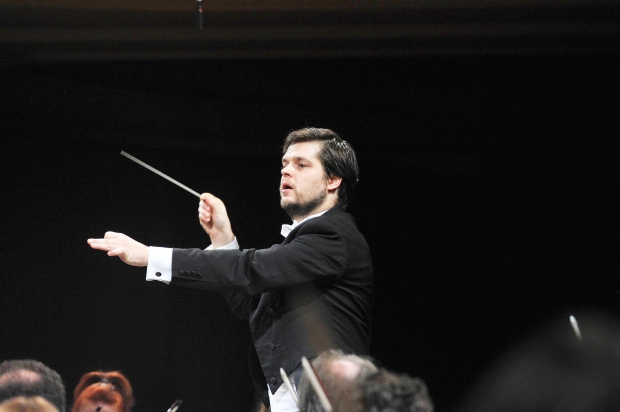
Juraj Valcuha at the podium

Conductor Juraj Valcuha and piano soloist Andre Watts spark fireworks Rachmaninoff Piano Concerto No. 2

NEW YORK---It has been 50 years since piano giant Andre Watts made his New York Philharmonic debut at the tender age of 16. His appearance this past week as guest soloist with young Slovakian conductor Juraj Valcuha, in his New York Philharmonic debut, could not have been more revelatory. Their pairing in the Piano Concerto No. 2 by Sergei Rachmaninoff as the centerpiece of a program dominated by operatic themes by Carl Maria Von Weber (Overture to Oberon)  and Richard Strauss (Symphony Fantasy on Die Frau ohne Schatten and Suite from Der Rosenkavalier) showcased both the work of a seasoned professional and that of a meteoric talent on the rise.

Valcuha is currently the chief conductor of the Orchestra Sinfonica Nazionale della RAI in Torino, Italy and has debuted to critical acclaim with such prestigious orchestral bodies as the Berlin Philharmonic, San Francisco Symphony and Filarmonica della Scala in Milan. Watt's current tour schedule includes the majority of the great orchestras and concert halls of the globe.

Weber's sprightly Overture to Oberon opened the program on a good humored note, allowing both the conductor and the orchestra to flex their tonal muscles in advance of the heavy musical lifting that would follow. Valcuha even got in a bit of podium aerobics, nimbly bouncing on tip-toe to the music and bending deeply into the front row of violins as he coaxed them to greater sonic emphasis.

Andre Watts has lost none of the intensity that quickly brought him to the apex of a brilliant career that has survived the test of time. His phrasing from the opening passages was fraught with emotion. His face awash with expression, he caressed the keys in the romantic melody of the famous Adagio sostenuto. Although popularized ad nauseum in the films and pop music of the last century, Watts made it sound anew. A hushed exchange between the woodwinds and Watt's restrained, yet emotive playing was made even more exquisite by Valcuha's sympatico at the podium. At the conclusion of his spine-tingling performance, Watts paused, allowing the resounding chords and depth of emotion to sink in.  Appearing to wipe a tear from his eye, he proceeded to dazzle the audience with his  display of pianistic prowess. He forged into Rachmaninoff's intricate musical maze, dispatching it with ease. Extended runs of 16th notes were precise and articulated. His lengthy, sustained tremello  was a marvel to behold. As orchestra and soloist thundered to crescendo, the audience was brought to its feet in a rapture of sustained applause, acknowledging a landmark performance.

Strauss's frothy, but inspired compositions from his well-known operas were handled with authority and imaginative spurts of brilliance. Valcuha has studied Strauss well and knows how to mine each measure for its finely faceted diamonds of musical sparkle.  The Suite from Der Rosenkavalier, in particular, captured the imagined and fantastic majesty of its stylized grandeur. Its premiere in 1911 was recognized as one of the great events of operatic history. Valcuha and the New York Philharmonic recaptured that festive spirit at this performance in Avery Fisher Hall.


Thursday, December 6, 2012


 Dave Brubeck celebrating his 89th birthday after receiving a Kennedy Center honor
 Jeff Lindberg and his Chicago Jazz Orchestra at the post awards ceremony dinner dance at Kennedy Center
The White House reception for the 2009 Kennedy Center Honorees


Remembering Dave Brubeck: A Lifetime of Creativity and Innovation

Story and photos by Dwight Casimere

This morning would have marked the 92nd birthday of one of the greatest jazz legends of our time, Dave Brubeck.  He died at the age of 91, near his home in Wilton, Connecticut.

The Chicago Tribute reports that Brubeck was en route to an appointment with his cardiologist when he was stricken Wednesday morning, said his longtime manager-producer-conductor, Russell Gloyd. The pianist died of heart failure at Norwalk Hospital, in Norwalk, Conn., near his home in Wilton, Conn.


Brubeck was anticipating a birthday concert Thursday, when he would have turned 92. The performance will go on, but in the form of a tribute, in Waterbury, Conn.


New York--I arrived at Reagan International in the midst of a surprise snowstorm and freezing sleet-turned to snow on a chilly December night after a hastily arranged flight from my then-home in Miami, to attend the 32nd Kennedy Center Honors at Kennedy Center. Ironically, just hours before, I was standing outside the Miami Beach Symphony Center, interviewing Sean Penn in 80 degree weather, at a benefit concert he was holding during Art Basel. The trip to D.C. came about because a musician friend of mine, Jeff Lindberg, who is music director of the Chicago Jazz Orchestra, had arranged for a last-minute invitation, actually, a backstage pass, for me to attend the Kennedy Honors awards presentation and subsequent dinner, where his band has provided the music for the past 25 years. I wanted to attend this particular awards ceremony because one of the idols of my youth, Dave Brubeck, was the recipient of  one of the awards. 
On the night of the award, Brubeck was celebrating his 89th birthday.  Hearing of his passing, just short of his 92nd birthday, I began to reflect on my long personal association with the artist and my lingering admiration of him.

I first encountered Dave Brubeck when I was working as a news anchor and reporter at KGO-TV in San Francisco. What a treat it was when I learned that I had been assigned to cover the opening of the Concord Pavilion, an outdoor concert venue, similar to Ravinia Festival in Chicago and Tanglewood in Massachusetts. Dave Brubeck was the headlining act. It was significant because Brubeck was born and raised in Concord and this was a shining example of a "home town boy making good." The crowd was overflowing and effusive in its admiration. It was my privilege to meet Brubeck backstage and to interview him for a TV news feature. As a young music student in Chicago, I had learned to appreciate his artistry and spent many hours practicing the music he had written.

I next encountered Brubeck in my early 30s, when I had moved back to Chicago from San Francisco. I had joined Fourth Presbyterian Church in Chicago's Gold Coast. Coincidentally, at the time, the Music Director and choir Master was Russel Gloyd, who was also the Music Director for Dave Brubeck. Each year, Brubeck and his quartet would travel to the Windy City to give a concert of his religious music with the Fourth Presbyterian Church choir and members of the Chicago Symphony Orchestra. Because of my church membership and media affiliations, I was regularly afforded a seat in one of the the front row pews to witness this extraordinary melding of faith and creativity.

The Fourth Presbyterian Church connection is signigicant, because, as a teenager, I was deeply intrigued by Dave Brubeck's compositions, in which he explored the combination of jazz as it relates to religious themes. Brubeck wrote a number of religious compositions and performed them regularly in benefit concerts around the world. As a teenager, while attending Englewood High School in Chicago, I was inspired by my music teacher and mentor, Harvey Pranien, who is now a Fine Arts dealer in Evanston, Illinois, to write a piano jazz suite based on the Passion of Christ, much in the fashion of music written at the time by Brubeck. Pranien arranged for me and my trio to perform the music I had written at Fourth Presbyterian Church in the very same sanctuary where Brubeck later performed his jazz/religious compositions. Brubeck and I joked about the irony of this during a backstage conversation at one of his last Fourth Pres concerts a few years ago.

Once, in a summertime concert at Ravinia, outside Chicago, I was again afforded backstage access to interview Brubeck and to spend a few moments chatting with the great artist over a bottle of cranberry juice. At the time, he was admiring a bronze-colored velvet sportcoat that I was wearing. I offered to give it to him. He of course, refused. After I insisted, he proposed a deal, he would give me a signed copy of his latest CD, "New Wine," in exchange for the jacket. Deal! I subsequently gave the CD to my daughter as a Christmas present. She still treasures it to this day. Ironically, I had informed Brubeck that I was embarking on a new venture, writing about wine and developing avenues for exposing my newfound passing in the media. After much travail and time, that passion has now become my full-time profession. But, I digress. The real purpose of this treatise is to vent my personal grief at the loss of this  pivotal figure in my life. 

In my formative teen and early adult years, there were two people that I idolized and who shaped my philosophical and intellectual template, Dr. Martin Luther King Jr. and Dave Brubeck. On the surface, these two people could not appear more disparate. But, if you look deep inside them and into their life's body of work, there could not be more commonality betweeen them.
Here now is the text of my post from the 32nd Kennedy Center honors in December, 2009:

Jazz legend Dave Brubeck celebrated his 89th birthday by receiving his ultimate birthday wish: being named as one of the honorees at the 32nd Kennedy Center Honors. “I never thought this day would happen,” he said at a star-studded dinner in the rotunda of the Kennedy Center following the three and a half hour tribute program, attended by President Barack Obama and “First Lady Michelle Obama. “I’m still having trouble believing its true!”
Brubeck, who changed the face of jazz fifty years ago with his landmark recording of the composition “Take Five”, written by his alto saxophonist, Paul Desmond. “My label, Columbia, was hesitant to release the album,” he said, “because it broke new ground. Nobody had ever heard a jazz tune in 5/4 time. Everything followed the traditional 4/4/ time. The record company just didn’t think people would accept it.”
Fortunately, for Brubeck and the jazz-listening world, they were wrong. The album, “Time Out,” became the best-selling jazz LP of all time.
Brubeck was among the most stellar collection of honorees assembled in the event’s history, opera great Grace Bumbry, who broke opera’s long-standing color line, actor Robert De Niro, who Meryl Streep credited with “practically creating his own school of acting that we all tried to emulate,” rocker Bruce Springsteen, who received both heartfelt tributes and songs from legends Aretha Franklin, John Mellencamp, Melissa Etheridge and Sting and comedian-actor-director Mel Brooks, who was lionized by protégés Matthew Broderick, Martin Short and Ed Norton.
Chicago Jazz Orchestra, in their 21st straight year, provided the musical footnote to the elegant dinner following the tribute in the rotunda of Kennedy Center, under the watchful eye of the giant bust of President John F.Kennedy, for whom the arts and entertainment center is named. Vocalist Frieda Lee provided Ella-like song stylings, with jazz greats Herbie Hancock and Terrance Blanchard among the audience.

Tuesday, November 20, 2012

The Tempest Met Live In HD is a stunning original


MET LIVE HD: THE TEMPEST REINVISIONS SHAKESPEARE’S CLASSIC

Composer conducts new production, directed by Robert Lepage

Reviewed by Dwight Casimere
Photos: Ken Howard/Metropolitan Opera

 Simon Keenlyside as Prospero with Isabel Luna as Miranda
 Mezzo-soprano Isabel Leonard as Miranda, daughter of Prospero
 Bass Alan Oke as Caliban
 Coloratura soprano Audrey Luna as Ariel
 Acrobatic dancer Jaime Verazin performs aerial stunts as Ariel
Simon Kennlyside is a commanding Prospero

NEW YORK—With brilliant staging, sets and costumes and emotionally riveting conducting by the composer at the podium, Metropolitan Opera’s new production of “The Tempest” promises to be the most successful work of the 2012-2013 season.

Seen in the theatres around the globe in Met Live in HD, The Tempest, directed for the Met by Robert Lepage and for Live in HD by television’s Gary Halvorson,

With stunning genius, director Lepage chose to set the opera within the confines of the citadel of the opera world, backstage at La Scala, which is, coincidentally, located in Milan, the home of the ousted eccentric Duke Prospero. Prospero, recreates the opera house of his homeland on the remote, stormy island to which he has been expelled for his sorcery./ Sung with almost creepy cunning by the vocally chilling baritone Simon Keenlyside, Prospero appears as a tattooed madman who manipulates people’s thoughts to the point of altering their surroundings. In that respect, he is like the omniscient general manager of a fantastic opera company. Kym Barrett’s costume,  depicts him as a tattooed, slithering wild man with a Vegas/Elvis slither running down his spine.

Ade’s score is dense, dark and complex, yet it holds your attention from beginning to end. “I’ve never sung so many difficult intervals in my life!” confessed mezzo-soprano Isabel Leonard, who sang the role of Miranda, Prospero’s daughter in a backstage interview with Met superstar and Live In HD host Deborah Voigt. Keenlyside and Leonard carried their substantial roles with authority and aplomb. The most vocally challenging singing role, however, went to coloratura soprano Audrey Luna as the spirit Ariel. Although aerial artist Jaime Verazin performed the majority of the actual acrobatics, Luna was still required to do some considerable maneuvering well-above stage level. In addition to the demanding, stratospherically high arias that tested even her ravishing, cosmic voice, she was required to be suspended,  almost Cirque du Soleil-style, while singing punishingly high, staccato intervals. All this while wearing a rather bizarre jagged-wing costume. The overall effect was a bit disconcerting, but her phenomenal singing made it a focal point of the opera.

If there were an opera Oscar for Best Performance while performing impossible aerial stunts, Ms. Luna would be the hands-down winner.

Bass Alan Oke lent an air of dramatic gravitas to his supernatural character Caliban.

It’s not often that an opera composer gets interviewed backstage during a Met performance and even more rare, the fact that that he is also the conductor of the Metropolitan Opera Orchestra in the pit. Thomas Ades appointed himself well, with deeply moving declamations of his own score. The orchestra never sounded better and seemed to reach a depth of emotion that even surpassed the superlative work it did during last season’s Ring series, also directed by Lepage.

Ades was just 32 when his work had its premiere at the Royal Opera at Covent Garden in 2004. In the past eight years, there have been no less than four original productions of his work, a feat almost unequaled by any other modern-day work. His music is rich and powerful and the libretto by Meredith Oakes presents Shakespeare’s poetry in a manner that is both accessible to modern audiences and pleasing to the ear with its poetic symmetry which more approximates the rhyming lyrics of modern-day songs than the iambic pentameter of Shakespeare’s time.

“This is something I’ve wanted to realize almost since childhood,” Ades confided to backstage interviewer Voigt. “I first saw The Tempest as a child, growing up in England. I always had in the back of my mind, from the moment I started studying music, that I would somehow set his work to music myself and re-imagine it in my own way.”

For all intensive purposes, he has achieved that goal and beyond!

The Tempest will appear in a Met Live HD Encore Wednesday, November 28 at 6:30pm local time and in a Canada Encore Saturday, January 12 at 12 p.m. local time. 

Mozart's La Clemenza di Tito is the next Met Live In HD Presentation Saturday, December 1 at 12:55pm. Check local the listings for times and theatre locations or visit fathomevents.com or metopera.org.

Saturday, November 10, 2012

Gilberto Gil: Voices of Latin America Festival at Carnegie Hall

GILBERTO GIL TRANSFORMS STAID CARNEGIE HALL INTO A NIGHT IN BAHIA

REVIEWED BY DWIGHT CASIMERE NOVEMBER 8, 2012

NEW YORK--A capacity audience at Carnegie Hall on a chilly November night, hard on the heels of the devastation of Hurricane Sandy, attested to the tsunamic power of the Brazilian musician and cultural icon Gilberto Gil. Isaac Stern Auditorium was filled to capacity, with every Brazilian in a 500 mile radius in attendance. Gil dazzled, danced and discoursed through a kaleidoscopic journey through his more than 50 year music career, beginning with such favorites as Fe Na Festa, Three Little Birds and Casamento da Raposa. A devotee of forro, the pop/folk music of his native northeastern Brazil. He was inspired by its creator, the legendary Luis Gonzaga and was later influenced by Joao Gilberto and Jobim and the lilting melodies of the bossa nova.  Gil's intermissionless, more than two hour performance touched upon them all before breaking it all wide open with a medley of Bob Marley hits and reggae, which brought the audience to its feet and had them dancing the samba in the aisles. Carnegie Hall will never be the same!

Gil's concert was the first installment in the Voices of Latin America festival at Carnegie Hall that runs through December 11 and expands out into a city-wide festival in New York, celebrating Latin America's music and arts. The festival is curated by some of the guiding lights of Latin American music and culture, who will also be among its participants, including the brilliant conductor Gustavo Dudamel and his Simon Bolivar Symphony Orchestra of Venezuela (Dec. 9,10&11), Samba legendPaulinho da Viola (Nov. 28) and Latin jazz piano titan Chucho Valdez (Dec. 4). Another piano great, Danilo Perez, performs Dec 4 & 8. The festival will feature musicians, singers and dancers from the entire spectrum of Latin American music. The festival makes a pre-Holiday trip to New York an absolute must. 

Wednesday, November 7, 2012

Coltrane Alumni, Proteges Celebrate Genius at Jazz At Lincoln Center


John Coltrane Festival: Jazz at Lincoln Center
The Genius of John Coltrane
McCoy Tyner: The Gentle Side of John Coltrane

Reviewed by Dwight Casimere October 27, 2012

New York---Narrowly avoiding the devastation of Hurricane Sandy by just a day, Jazz at Lincoln Center presented a comprehensive tribute to The Genius of John Coltrane in a weekend-long festival that featured Coltrane alumnae, protégés and a host of brilliant young saxophonists inspired by his daring creativity.

The evening began with an absorbing chamber-jazz concert headed by legendary pianist, McCoy Tyner, a Coltrane mainstay from the glory days of Tranes stellar quartet, along with Coltrane protégé Gary Bartz, accompanied by Miles Davis alums Jack DeJohnette on Drums and Dave Holland on Bass. Held in the intimate Allen Room of Jazz at Lincoln Center, overlooking the sweeping panorama of Columbus Circle and Central Park, and entitled The Gentle Side of Coltrane, the quartet explored the tenor giant’s mastery of the ballad, as exemplified in such evergreens as “I Want to Talk About You” and the hauntingly reverential “Naima.” Composed in 1959 in honor of his first wife, Juanita Naima Grubbs, the composition first appeared on the groundbreaking album “Giant Steps.”  Saxophonist Gary Bartz, who revealed at a festival
Listening party for his new album “Coltrane Rules,” that he first met  Trane at the age of 14 at his father’s club in his native Baltimore, gave a fittingly energized rendition of the timeless classic.


 A Chicago Reuinion Backstage at Jazz at Lincoln Center with Richard Muhal Abrams (l), founder of AACM and Jack DeJohnette (r)


Gary Bartz in solo flight (middle photo) and at his John Coltrane Festival Listening party for his new album "Trane Rules"


By contrast, Tenor Saxophonist Joshua Redman and the Jazz at Lincoln Center Orchestra, minus Wynton Marsalis, gave a rollicking, roof-raising tribute to The Genius of Coltrane in a free-wheeling exploration of all of the original compositions and interpretations of the music associated with the acknowledged tenor master. Redman displayed the dazzling ‘chops’ that revealed him to be one the heirs apparent to the great one. Equally as meteoric were the solo performances of members from the entire saxophone section, including Victor Goines and Walter Blanding on Tenor Saxophone, Ted Nash on Alto and a particularly revelatory solo turn by Joe Temperley on Baritone Saxophone.
Pianist Dan Nimmer laid down a solid foundation for the fast-paced proceedings and displayed flashes of brilliance in his solos along with some riveting solos by Bassist Carlos Henriquez and the explosive drummer Ali Jackson, recalling the thunderous Elvin Jones of the original Coltrane Quartet.

It was a soul-stirring performance that gave deserved praise to one of the heroic voices of modern jazz.

Tuesday, November 6, 2012

Jack DeJohnette opens "Gateway" to Grammy-winning past at 70th Birthday Celebration


Jack Dejohnette opens “Gateway” to gloried past at CSO 70th Birthday Celebration

Reviewed by Dwight Casimere

CHICAGO—Jack DeJohnette, 2011 NEA Jazz Master and Grammy winning drummer, lauded as one of the most important musicians of the last 40 years, celebrated his 70th birthday in his hometown of Chicago, in a concert that reunited his 1975 Gateway album collaborators, Dave Holland on Bass and the equally celebrated John Abercrombie on guitar. All three have deep interconnections throughout their brilliant careers. Besides their historic Gateway recording, they also have connections through various musical tributaries, including live performances and/or recordings with the legendary Miles Davis and orchestrator Gil Evans. The lyricism and musicality of each of the musicians was evident both individually and collectively as DeJohnette explored original works by himself and his sidemen/collaborators. A special treat was a solo piano performance by DeJohnette, during which he revealed a little known fact known by only those who knew him in his earliest days as a journeyman-musician in his native Chicago, where he was best known as a pianist. The solos he played were crystalline in their perfection and belied traces of the delicate impressionism of Claude Debussy and the adventurous harmonics of Stravinsky.

Born in Chicago in 1942 on the South Side, home to many jazz legends such as Lionel Hampton and Nat “King” Cole, Sonny Stitt, Gene Ammons and others, DeJohnette fostered his career on the crest of a mountain of jazz legends. A graduate of Englewood High School, where this journalist was privileged to be a friend and fellow classmate, DeJohnette went on to New York to complete his education and, more importantly, embarked on a musical matriculation with the greatest names in music, most importantly, Miles Davis, in 1968, where he would participate in the historic recording Bitches Brew, acknowledged as the most ground-breaking jazz recording in history.


(The author backstage at Symphony Center with Grammy Award-winning NEA Jazz Master Jack DeJohnette. The two attended Englewood High School and the first year of college together before embarking on divergent careers in journalism and music.) 


That foundation of accolades was confirmed in this night’s concert at Symphony Center, consisting primarily of original compositions by each of the participants. The lyricism and creativity and overall spontaneity of each of the musicians were evident throughout. Their playing was more like a chamber ensemble than a traditional jazz trio, achieving more through quiet listening and organic response than the conventional explosive jazz solo romps that serve to accentuate individual virtuosity over collective harmonization. This was a meeting of the minds of three jazz masters, who sought to convey their unanimity of thought through individual expression. It was an experience that consumed the soul and invited the listener to participate as an involved witness. The effect was both engaging and satisfying on a deep level that was both sensual and psychological. Its overall impact will be felt by those who heard it long after the final percussive echoes that reverberated into the far reaches of Symphony Hall.