Tuesday, January 15, 2013

Chano Dominuez injects history of jazz piano into Flamenco Jazz

Photo courtesy Dizzy's Coca Cola/Jazz at Lincoln Center
NEW YORK---From the romanticism of Claude Debussy to the pre-modern rustlings of Maurice Revel, the inspired genius of Thelonius Monk and the cool jazz musings of Bill Evans and Miles Davis, pianist Chano Dominquez and his high-energy trio amp, injected a sense of jazz piano history into its presentation of Flamenco Jazz at Dizzy's Coca Cola jazz club at Jazz at Lincoln Center in the Time Warner Center of midtown Manhattan. The entire set had a sense of purpose about it, with Dominquez generously sprinkling in piano quotes from the masters of the instrument from Bud Powell and Monk to Bill Evans and the recently departed Dave Brubeck , all the while segueing into the Brazilian and Flamenco-styled references that provided entre' to the rustically charming vocals of Dafnis Prieto, with his John The Baptist mane of hair and fervent cries. Dominguez led the capacity audience through a master class of jazz piano improvisation from Chic Corea to Monk's "Ruby My Dear" to a touching rendition of Bill Evans/Miles Davis' "All Blues." Prieto punctuated each of the musical journeys with a detour into the realm of almost other-wordly whoops and cries that recalled the tribal "throat singing" of a timeless race and culture. It was a performance that both stirred and satisfied the soul.
Zukerman, Eschenbach inject new life into Bruch's war-horse Violin Concerto

Pinchas Zukerman by Paul Labelle

Reviewed by Dwight Casimere Saturday, January 12, 2013 at Avery Fisher Hall, Lincoln Center
NEW YORK-The National Theatre of Great Britain may have recently ended their Lincoln Center Theatre run of the epic drama War Horse a few weeks ago, but another 'war horse' of symphonic proportions was being put through its paces across the plaza at Avery Fisher Hall, as violin virtuoso Pinchas Zukerman and the esteemed German conductor Christoph Eschenbach as guests of the New York Philharmonic, led an inspired performance of the Bruch Violin Concerto No. 1 in G minor. Zukerman's playing was both soulful and probative throughout as Maestro Eschenbach kept a tight reign on tempos and timbre to create a sympathetic and, at times, contrapuntal thematic base to Bruch's rich, Romantic themes and lush accompanying orchestrations. The spiritual beauty of the Adagio and the almost chamber music feel of the interplay between the woodwinds and cellos and soloist Zukerman were among the most sensually satisfying moments of this superlative performance. As this was the soloists 100th performance with the orchestra, the sympatico between he and the assemblage was evident. Huge swells from the brass and timpani punctuated by the synchronized pulsations of the bass section made the Finale: Allegro energico, quite thrilling. Bruckner's Symphony No. 6 in A major, by contrast, was a somewhat solemn, measured piece of well-calibrated music, more intended to pierce the intellect than inspire the soul. Still, Eschenbach carefully mined its intricate depths like an agronomist searching for hints of jewels amongst the limestone. There were moments of brilliance and even joy in its carefully constructed measures. The Langsam (slow) movement at the conclusion of a rather subdued Scherzo (moderately fast) movement, was perhaps the highlight of the piece, achieving a sort of equipoise under Eschenbach's skilled hand. He also managed to imbue the Finale with an air of suspense, building to an explosive crescendo that brought the audience to its feet with thunderous applause.
Monday, January 14, 2013
Les Troyens an Epic at Met Live HD in Movie Theatres Worldwide


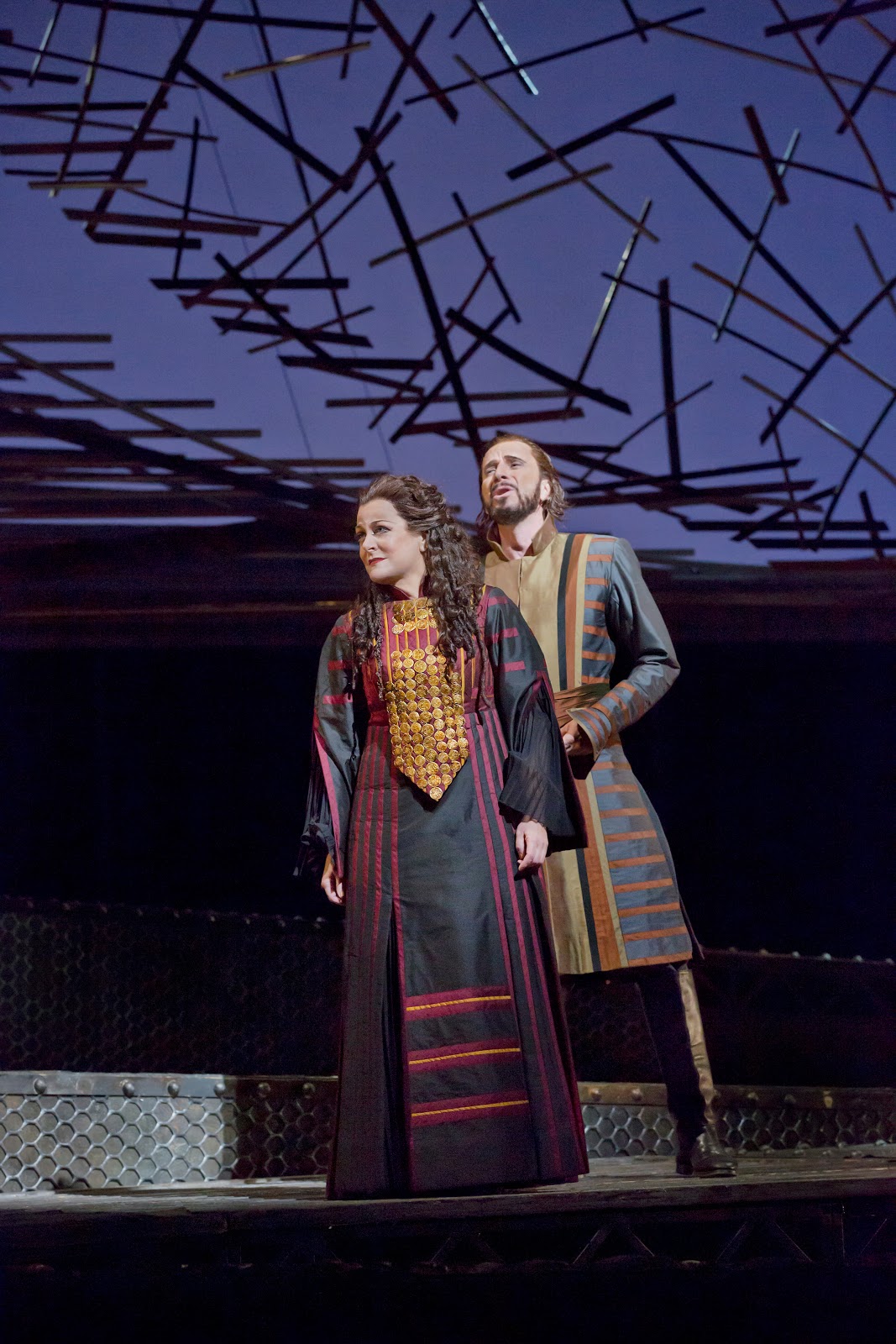
Reviewed by Dwight Casimere
Met Opera Photos by Ken Howard/Marty Sohl
NEW YORK--A stellar all-American cast in a pull-out-all-the-stops production of Hector Berlioz's "Les Troyens" marked the Metropolitan Opera's observance of the composer's 200th birthday anniversary and the halfway mark of the Met's Live in HD season. With an encore performance set for Wednesday, January 23 and 6:30pm local time, this is a program that commands a second look.The next Met Live HD presentation is Saturday, January 19 at 12:55 pm ET, with Donizetti's Maria Stuarda (Mary Queen of Scotts) starring Joyce DiDonato, who also served as the backstage Met Live HD Host for Les Troyens.
Brilliantly staged by director Francesca Zambello, the production brought Berlioz' epic interpretation of Virgil's "Aeneid" into sharp focus through the exceptional camera work of Live in HD director Barbara Willie Sweete and her nimble multi-camera crew. With a stellar chorus, directed by Donald Palumbo, performing seamlessly throughout in scenes punctuated by a captivating corps du ballet, choreographed by Doug Varone,the production was both visually stunning and emotionally riveting. The more than five and a half hour running time, with two half-hour intermissions included, seemed to fly by. The singers were so emotionally engaging that the audience was involved in the epic story at every turn. The marvelous singing and their emotive gestures brought their characters to life and made them so much more than historical representations, but real flesh and blood characters trapped in a crucible of betrayal, love triangles and power-lust. The story of "Les Troyens" is familiar to most, ecompassing the Fall of Troy at the hands of the Greeks, who, after ten years of seige, left behind a giant wood horse as a gift. The horse, of course, was a decoy. It was filled with armed soldiers who would lay waste to Troy once it was brought within the gates of the city.Deborah Voigt is the doomed Queen Cassanera, in her greatest role since that of Brunhilde in last year's Met production of the Ring cycle. The action in the second half of the opera moves to Carthage, North Africa, where Aeneas, sung forcefully by Bryan Hymel in his Metropolitan Opera debut, vows to fulfill his destiny as foretold by the gods to found a new empire (Roman) in Italy. Dido, sung dramatically by soprano Susan Graham, at the end, foretells the doom of the Roman Empire at the hands of a fellow member of African nobility, Hannibal. The sets, designed by Maria Bjernson, emphasize the sense of impending doom with a giant surrealistic globe hovering over the expansive wasted futuristic landscape of a set. The electrifying costumes by James F. Ingalls heightened the sense of other-worldly oppulence. Met Maestro Fabio Luisi led the orchestra with a firm hand, emphasizing the panoramic grandeur of the opening acts and the more intimate drama of the final scene with equal skill. Choreography by Doug Varone gave particular elegance to the lengthy ballet scenes. It will all be repeated in an Encore Presentation Wednesday, January 23 at 6:30pm local time. Check local listings for theatre locations. "Les Troyens" is experience well worth repeating.
Monday, December 17, 2012
MET OPERA IN LUMINOUS REVIVAL OF VERDI'S OTELLO
VERDI'S OTELLO IN LUMINOUS REVIVAL ONSTAGE AT
THE MET AND LIVE IN HD IN THEATRES WORLDWIDE
by Dwight Casimere


RENEE FLEMING IN ALL HER GLORY AS DESDEMONA IN VERDI'S OTELLO
Metropolitan Opera photos by Ken Howard
NEW YORK---Audiences
around the world were privileged to watch one of the world’s great Desdemona’s
perform the role Live in HD, as Renee Fleming reprised the role she first
performed for her first Met opening night 17 years ago in Verdi’s
“Otello.” The opera runs through
March 30 live on the stage of the Metropolitan Opera through March 30, with a
rotating cast. Future Encore performances in movie theatres will be announced
in the coming months. Check metopera.org or fathomevents.com for dates and
details.
Fleming doesn’t just
perform the role of Desdemona, she inhabits it, investing herself fully in the
drama and pathos of the character and lending a soft, velvety tone to such
gentle arias as the “Willow Song” and the ravishingly dramatic “Ave Maria”
which precedes her doom at the hands of the maddened Otello in his rage which
is fueled by jealousy.
Tenor Johan Botha is
most convincing as the headlong Moor, applying both the lumbering movements of
his massive physique and the immense power of his burnished mahogany voice to
convey the gradually unraveling emotional threads of Otello as he descends into
madness.
Bass-baritone Falk
Struckmann nearly stole the show, however, as the cunning Iago, chillingly
portraying his ruthless nature in an aria that almost makes the blood curdle. His
“Era la Notte” ends on an ominous note.
Conductor Semyon
Bychkov kept the tension building during Verdi’s lush, dense score, maintaining
a taut energy that underscored the opera’s mounting sense of tragedy. Verdi’s “Otello”
is perhaps the greatest example of the composer’s dramatic genius. The Met’s
absorbing remounting of this classic tale of deception and jealousy is one
worth revisiting time and again.
Philharmonia of London on triumphant North American tour with Esa-Pekka Salonen at the helm
FAMED PHILHARMONIA
ORCHESTRA EXCITES AUDIENCES ON NORTH AMERICAN TOUR


by Dwight Casimere
CHICAGO—It has been
decades since the famed Philharmonia Orchestra of London has graced the stage
of the Armour Stage at Chicago’s Symphony Center although its current principal
conductor, Esa-Pekka Salonen has been a frequent favorite guest conductor since
his splashy debut there nearly 25 years ago.
The Philharmonia
stopped in the Windy City during an eight-city North American tour that
included a program of tried and true audience favorites, Beethoven’s pensive
Second Symphony and Berlioz’s showy Symphony fantastique. The orchestra’s tour
began in downstate Champaign-Urbana near the University of Illinois and ended
in New York City in the Lincoln Center presents Great Performers series,
November 18 & 19 at Avery Fisher Hall.
The legendary
Finnish conductor displayed his prowess and mastery of tempo from the very
outset. His ability to turn a phrase from thundering crescendo to pianissimo on
a dime was a marvel to behold. Strings were especially prominent in the
Larghetto with their deep, burnished tone and free-flowing rubato. At times,
Salonen elicited a sweetened tone that balanced the sometimes-blaring tones of
the brass. The timpanist was noteworthy with his exceptional tone and forthright
playing. Salonen’s overall approach to the work brought it into focus,
improving the pace and performance as it went along in spite of a few awkward
moments at the outset.
Berlioz’s Symphony
fantastique was obviously the orchestra’s strong point. Salonen realized the
French composer’s volatile vision with a firm hand, placing sharply defined
emphasis on the most adventurous measures, yet allowing the individual
components of the orchestra to express their individuality. There were some
exquisite moments, beginning with the achingly lyrical playing of the strings
in the opening measures, through the dancelike airiness of the waltz movement,
Un Bal that saw the conductor almost dance ‘en pointe’ on the podium. The tension he built during the “March to
the Scaffold” erupted in a fiery conclusion that brought the audience to its
feet. The Prelude to Act III of
Wagner’s Lohengrin provided an explosive display of virtuosity by the
Philharmonia’s exceptional brass section.
Subscribe to:
Posts (Atom)