Thursday, February 13, 2014

Post SuperBowl 2014, Renee Fleming proves she's the best in Met Opera Live HD Rusalka

by Dwight Casimere


PHOTO: Ken Howard/MetOpera

NEW YORK--Anyone who didn't know who Renee Fleming was before her singing of the Star Bangled Banner before millions in a worldwide television audience before Super Bowl XLVIII, certainly knows who she is now. If they attended the Met Live HD transmission of the opera Rusalka in movie theaters around the globe, they would have gotten a chance to see her in action on her 'day job' at the Metropolitan Opera, in one of the signature roles of her career. Anyone who missed it, will get an opportunity to see her again in the role, when the Met encores the Live HD performance in U.S. theaters Wednesday, February 12,  6:30pm local time. Canadian audiences will experience an Encore performance on Saturday, March 29 at 12pm ET and again on Monday, March 31 at 6pm local time.

In a fashion that ironically mimics the beginning of many football star's careers, Renee Fleming  burst onto the opera scene twenty-five years ago after catching the attention of opera scouts at the Met's National Council Auditions. She has since sung the role at the Met more than any other singer in Met  history. Sitting in the  darkened theatre at the AMC Empire 25 in Times Square, it was easy to see why. Renee Fleming is Rusalka, in all of her mystical, nymph-like glory, with an ethereal voice that has even become more alluring over time.

Conductor Yannick Nezet-Seguin leads an all-star cast, including Polish tenor Piotr Beczala as the strikingly handsome Prince. His command of the linguistically difficult Czech text wrestles this somewhat forward, abrasive sounding language to sheer lyrical poetry with his strong, yet supple voice. Dolora Zajick, as the deliciously evil witch Jezibaba, sends her powerhouse voice vaulting to the rafters, at times matching reverb for reverb the booming sounds of car crashes and explosions leaking over from the SciFi  action film RoboCop showing in the movie theatre next door.

Met favorite John Relyea gives a forceful, tongue-in-cheek performance as the Water Gnome and New York native Emily Magee acquits herself well in her Met debut as the Foreign Princess. It's almost worth seeing this production twice, if only to hear Renee Fleming sing Dvorak's "Song to the Moon" in the opening act.            


Photo: Ken Howard/Met Opera

Monday, January 20, 2014

Roam around Rome-Part III; "Hidden Rome;" inside the Jewish Ghetto and Trastevere

An "insiders" view of Rome from its historic neighborhoods to ancient ruins

Story and photo gallery by Dwight Casimere


ROME, Italy--The Coliseum, the Pantheon, the Spanish Steps and the Plaza Navona are all at the top of the list of tourist attractions for anyone visiting "the Eternal City." Beneath their magnificent facades lie centuries of history and hidden treasures, some visible to the naked eye, others only revealed by exploring deep beneath the surface of Rome's cobbled streets.

Such was the experience of an Educational Tour 2013 organized and sponsored by Promoroma, the special Agency of the Chamber of Commere of Rome, and conducted by their consultants, Roam around Rome, vacations made to measure.  Long walks through Rome's labyrinth of streets and alleyways revealed its rich tapestry of history and culture. Tour guides Pier Paolo Meschini and Antonio Rinaldini expertly peeled away layers of history to expose the truth behind legends and the facts behind many widely accepted truths.


The Spanish Steps (Scalinata della Trinita dei Monti), the widest staircase in all of Europe. was actually built with French money. The diplomat Etienne Gueffier bequethed funds in 1723-1725 to build the steps on the slope between the Spanish Embassy and the Trinita dei Monti church, which was under the patronage of the Bourbon kings of France and the Holy See in the Palazzo Monaldeschi below. If you look carefully at the scultural details, you'll see the well-known Fleur-de-Lys, symbol of the French Bourbon court.

Cameras and photography were not allowed at our next stop, but it best illustrated the fact of an historic facade concealing a vital part of Roman history, which was only revealed upon excavation beneath superficial ground.

After the Palazzo Valentini was commissioned to be built in 1585 by then Cardinal Michele Bonelli, a nephew of Pope Pius V, the building was later partially demolished and rebuilt. During the course of all of these restructurings, a treasure was discovered; the archeological remains of adjoining ancient Roman houses.  A team of historians, archaeologists and architects, all working for the Roman Provincial Administration researched and then restored the excavations, which are now on public display. Walking through the darkened passageways and peering through the glass floor of the "Domus Romane," one can see the grandeur of Roman life in the remains of the home's subterranean chambers.  The house was divided between the main living area, the gardens and the servants quarters. Underground passageways led to the famed "roman baths" which were a lbyrinth of steam rooms, fueled by underground geysers and streams, large bathing areas with cabanas and lounges, game rooms, replete with the remnants of ancient game pieces and gaming boards and private chambers where whispered plots and assignations took place. The darkened spaces all came vividly to life through the stories narrated by the guides. Elaborate inlaid tile floors and wall carvings gave a clear indication of the grandious surroundings that once gleamed brightly so many thousands of years ago. Roman life was luxurious and sophisticated.  Every member of the Roman elite lived like Donald Trump!  The nobility of the time enjoyed pleasures, not unlike those taken for granted today; hot and cold running water, indoor "plumbing, sumptuous baths rivaling anything made by Kohler, walls lined with beautiful artwork, kitchens that turned out lavish gourmet meals and myriad entertainments provided by their slaves. Colorful drawings and friezes along the walls revealed a continuous story line that was viewed at leisure by frequenters of the baths. They could be looked upon as the first "movies."

The Trastevere, in the heart of the city, is the home of poets and artisans. It now is the epicenter of the city's nightlife,with restaurants, cafes and quirky boutiques. The area has a dcidedly Bohemian air, not unlike New York's Greenwich Village. A favored destination for night-lifers because of its bars and clubs, it is also the locale for many important monuments from the past, including the Monte dei Cocci, an articial mound dating back to the ancient Romans, who used to dump their broken pieces of pottery onto a gathering pile of earthenware that now looks like a hill.

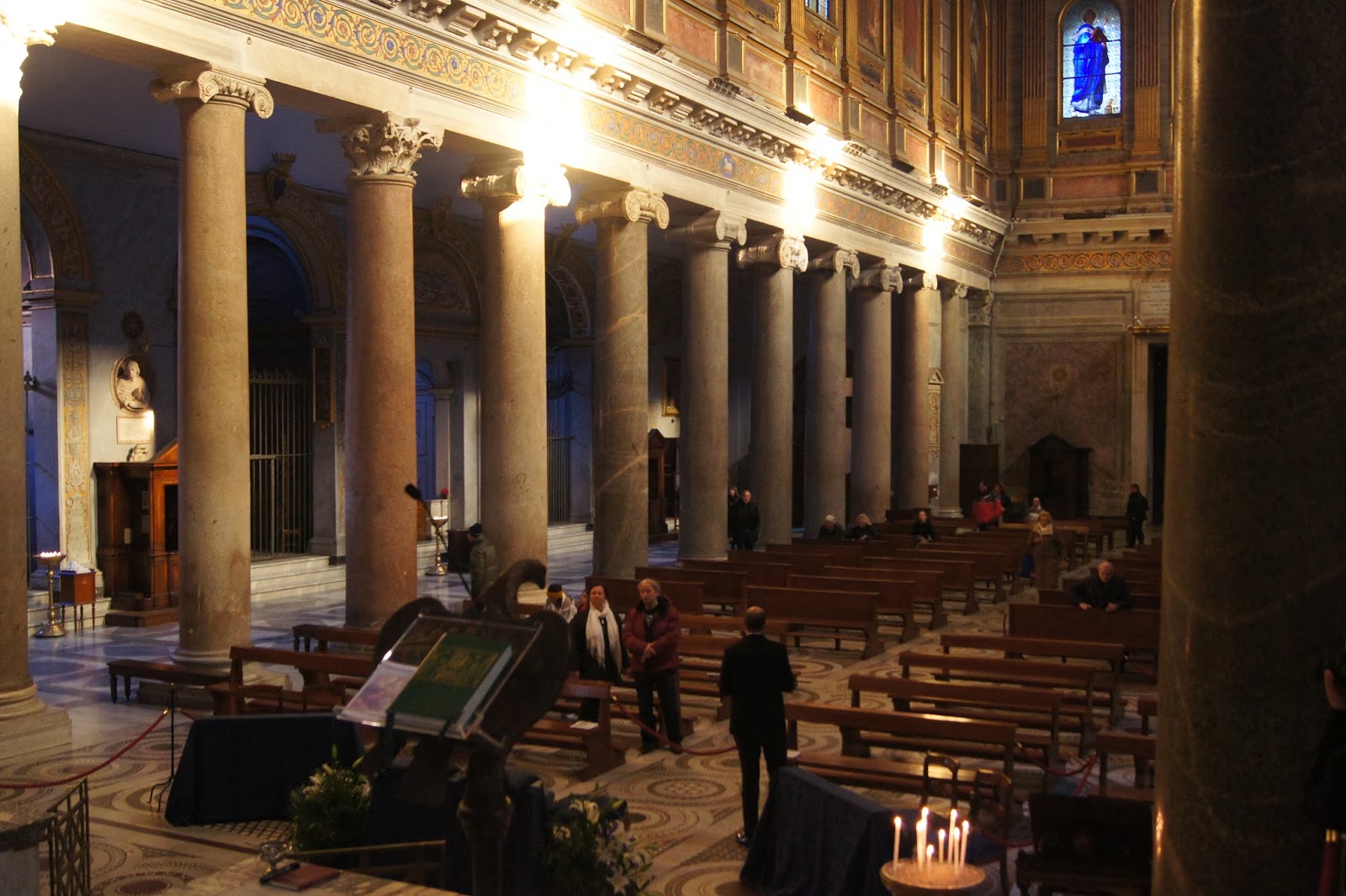
Dominating the main square in the Trastevere is the ornate church, the Basilica of Our Lady, Santa Maria. The inscription on the episcopal throne states that it is the first church dedicated to Mary, the mother of Jesus. That fact remains in dispute, but what is indisputable is that it is the oldest Christian church in the city,

The Tiber River is the main watercourse of the city of Rome, and its demarcation line. Numerous famous bridges traverse its rushing waters and divide the city into its many historic districts. Among the most fabled is the Jewish Ghetto. Established first by Pope Paul IV between 1555 and 1559, it cramped several thousand people behind its walls, contributing to the oppression of the Jews during the Italian Renaissance. Later, in 1492, it became a refuge for Jews who emmigrated by the thousands to escape torture and execution during the reigh of Queen Isabella and King Ferdinand of Spain. It was Pope Alexander VI (1492-1503) who enlarged the ghetto and defined its current boundary along the banks of the Tiber River.

A grim reminder of the Holocaust is embodied in a plaque on the doorway of an apartment building at the mouth of the ghetto, which marks the capture and subsequent liquidation of scores of children who were wrested from the ghetto and hauled away to the concentration camps.

Today, the Jewish Ghetto is a lively place, filled with street vendors, sidewalk musicians, vibrant cafes and restaurants renowned for their fusion of Italian and Jewish cuisine. The sights, sounds and smells of the Jewish Ghetto tantalize and delight, inviting endless exploration and degustation. An afternoon lunch that lasted for nearly three hours, caused our group to miss out on visiting a whole list of  historic sites on our itinerary. Nontheless, the lunch, with its fusion of Jewish and home-style Italian specialties, was one of the most memorable in recent memory. The gustatory rewards made up for the lapse in scheduling. What better way to experience the history and culture of a place than by imbibing its wine and cuisine!
 The famed Spanish Steps with the Trinita del Monti church at the top of the stairs
 At the ruins of Ancient Rome

 A denizen of the bridge at the Tiber River
 Insdide the Jewish Ghetto


The Tiber River and one of its many bridges

 African street merchants at the gateway to the Jewish Ghetto
 The faces of the Trastevere

                                      
 A wedding at the Basilica di Santa Maria in Trastevere


The wedding gets underway at Basilica di Santa Maria


Saturday, January 18, 2014

Roam around Rome ll-the city of "La Dolce Vita" (The Sweet Life) where the word "romance" was born

Rome: the city of love, immortalized in film, song and art

Story and photo gallery by Dwight Casimere


ROME--There is no more powerful romantic image in the annals of film history than a single scene in the romantic drama "La Dolce Vita" by director and writer Federico Fellini. In the film, the sexually charged Swedish-American actress Sylvia (played by a ravishing Anita Ekberg), seduces a star-hungry Italian journalist Marcello (Marcello Mastroianni) by leading him through the back alleys of Rome after a wild orgiastic party, only to coax him into wading and cavorting with her in the Trevi Fountain in the wee hours just before dawn. (In real life, according to the producers, the scene took a week to film in the dead of winter when the water was ice cold. Mastroianni reluctantly consented to film the scene only after Fellini provided him with a wet suit to wear under his suit.  Ekberg, although a superstar in both Europe and America, bore no complaint and stayed in the water for hours during the filming, clad only in her evening gown.)  It is a captivating and enduring image of love carried forth with reckless abandon and it won the film critical acclaim worldwide, garnering millions in theatrical tickets sales in the U.S.-perhaps the most widely viewed foreign film of its time, and garnering four Oscar nominations. It ultimately won  the Academy Award for Best Costume Design for a Black and White Film at the 34th Academy Awards in 1962.

The Fontana di Trevi (Trevi Fountain) is a focal point of Roam around Rome, vacations made to measure, conducted by founders Pier Paolo Meschini and Antonio Rinaldini. The affable tour guides use their combined love for their native city and their extensive insider knowledge of the personal "stories behind the monuments" that make theirs one of the most intimate and memorable travel experiences, elevating the act of sightseeing to a new, and heightened level. Roam around Rome are consultants to Promoroma, a special agency of the Chamber of Commere of Rome, organizers and sponsors of the Educational Tour of Rome 2013.

The story behind the Trevi Fountain is rife with myth and fact that reads as such. Designed by the Roman architect Nicola Salvi, the fountain took more than 30 years to construct. In fact, Salvi died before its completion and it was left to the designer Giuseppe Pannini to finish the fountain in 1762, making some alterations to the orginal design, but keeping its central themes; a mixture of classical and allegorical figures and combinations of a palatial facade with what appeared to be natural rock formationscomplete with fissures gushing forth water like natural waterfalls and geysers. It is a dramatic piece which, ironically, seems to grow organically from an attached apartment building. It is a rather curius, yet dramatic juxtaposition in the heart of this bustling city.  Legend has it that a tourist must throw coins n the fountain to ensure a return trip to Rome.

The Trevi Fountain and its legend were the also the inspiration for the 1954 Academy Award-winning romantic comedy film "Three Coins in The Fountain."  The film won two Academy Awards at the 27th Academy Awards in 1955 for Best Cinematography and Best Song (Three Coins in the Fountain,  and was nominated for Best Picture.

This Baroque inspired fantasy that is Trevi Fountain is massive, both in physical size and design and structural scope. When one visually compares it to its locale, at the foot of a busy intersection of streets filled with designer shops and cafes and the Piazza di Trevi, a neighborhood square, it appears almost too large for the space it occupies!

This is but one of the visual contradictions among the historic treasures to be explored in the course of a day with Roam around Rome. The Trevi Fountain and its romantic history is but one of the behind-the-scenes gems revealed by Pier Paolo Meschini and Antonio Rinaldini in a delightful afternoon of exploring Rome on foot, perhaps the best way to take in the myriad sights and sounds of this Eternal City.
 At the Trevi Fountain


 Marcello Mastroianni and Anita Ekberg cavort in the Trevi Fountain in La Dolce Vita


 Vatican City as seen from Caffarelli Terrace
Below: On the famed Spanish Steps

Saturday, December 21, 2013

Roam around Rome: vacations made to measure


Story and photo gallery by Dwight Casimere

The view from Caffarelli Terrace

Below: lunch at the Terrazza Caffrelli


A view of the Capitol and the Capitoline Musems
Enjoying a glass of Prosecco on the Terrazza
Outside the Capitolini Museum

Below: Scenes of Ancient Rome


Dinner at Harry's Bar


Winemaker and owner Marco Caldani with his excellent Gelso della Valchetta wine
Harry's Bar by night


Rome, Italy--There are rare occasions  when a single event can change the course of your life, or at least your perception of it. Such was the case in a recent Rome Educational Tour sponsored by Promoroma, the special agency of the Chamber of Commerce of Rome, conducted by their consultants, the Roam around Rome tour agency and its affable and accommodating  guides Pier Paolo Meschini and Antonio Rinaldini. Their sensitive portrayal of the history and culture of Rome through the lens of their personal perspective and life-long experience made this a travel experience that transcended the mere physicality of the ancient ruins and monuments, giving them breath,  life and vitality.

Our tour allowed us to experience Rome from the very heights of its grandest vistas to the depths of ancient civilizations buried in hidden labyrinths beneath some of the city's most established treasures. It is these secret chambers and the barely discernible meanings behind the inscriptions etched in stone on their crumbling walls, that the particular insights of our tour guides became most evident.  Their words brought illumination to darkened passageways and faded markings. Personal anecdotes about the ancient families and their fabled past brought the gleaming images of marble statues and fountains into even sharper relief against the azure brilliance of the Roman sky. This was Rome as never seen before, more beautiful, picturesque and storied than any documentary or dramatic film.

A short van ride from the quaint and beautifully appointed Hotel degli Aranci in the "Embassy Row" and orange tree-lined streets of the tony residential neighborhood not far from the Villa Borghese, and our party arrived for an intimate introductory luncheon on the outdoor terrace at the Terrazza Caffarelli high above the steps of the Capitol and atop the beautiful building that hosts the Capitoline Museums in Piazzale Caffarelli. This rare venue, with stunning views of the Capitol and sweeping panoramas of Rome proper, with Vatican City in the distance, offers a unique location for exclusive luncheons, dinners and private receptions as well as meetings and conventions. The management, coordinated by Relais le Jardin, creates events that match the extraordinary surroundings. 

The Capitoline Museums can be traced back to 1471, when Pope Sixtus IV donated the first group of bronze statues of great symbolic value to the People of Rome. This modest, but significant contribution served as the nucleus to a growing collection closely inked to the city of Rome, its history, culture and its people. Breathing the crisp early winter air and taking in the sun-drenched vistas and the delightfully rich local cuisine prepared by the Relaid le Jardin catering staff made this a truly unique experience that will be long remembered.

Following the fabulous lunch consisting of such local delicacies as Aranchini, Prosciutto, stuffed zuccini flowers and delicate pasta infused with fresh, local truffles, sprinkled with Pecorino Romano cheese and  roasted guinea hen with chestnuts and rapini, we then visited the nearby Domus Romane of Palazzo Velentini. 

The Palazzo Valentini, seat of the Province of Rome since 1873, was commissioned by Cardinal Michele Bonelli, a nephew of Pope Pius V, in 1585. When it underwent renovation in the seventeenth century, the archeological remains of  ancient Roman houses were discovered underneath. A team of art historians, archeologists and architects researched the remains and, through the Provincial Administration, restored the ruins and put the excavations on public display. The result of their work revealed a series of luxurious steam rooms, bathing areas and entertainment centers, punctuated by lavish gardens and gathering, lounging and gaming areas that rival the spas and country clubs of today. This was a significant revelation of the glorious lifestlye experienced by the wealthy elite of ancient Roman society and a glimpse into a highly advanced and sophisticated society that provides the historic underpinnings for the topography and culture of modern day Rome.

A leisurely late afternoon rest and it was time to freshen up and head for dinner in the nearby central area for dinner at Harry's Bar, made famous by the writings of Ernest Hemingway and the creation of the famous  Champagne and white peach nectar drink, the Bellini and Harry's  legendary continental cuisine which has lined the stomachs of celebrities from the literary, political, artistic and film world for decades. Many of the pictures of Harry's most prominent customers through the ages, shaking the hand of its founder Harry Cipriani and the current owner and manager of the Rome location, adorn the walls in its elegant, wood-paneled dining rooms and sumptuous and cozy bar, for which it is world-famous. This was a memorable evening of great cuisine and brilliant company in an historic surrounding that oozed charm. This is the Rome that inspired artists and poets and  La Dolce Vita and I was happy to be a part of it, if only for one evening!