Tuesday, October 9, 2018

MET OPERA SEASON OPENER SAMSON ET DALILA A SEXY, EYE-POPPING SPECTACLE


 ROBERTA ALAGNA AND ELINA GARANCA IN THE TITLE ROLES
 SENSUOUS DANCE SEQUENCE BY AUSTIN MCCORMICK OPENS ACT III
SAMSAON PRAYS FOR STRENGTH IN THE FINAL MOMENTS 


by Dwight Casimere
Photos:Ken Howardl/Metropolitan Opera

With a glitzy new production by a Broadway, Tony Award-winning team, and the star power of opera's most celebrated onstage couple,  the Metropolitan Opera opened its 2018-19 Season with Camille Saint-Saens's Samson Et Dalila. Tenor Roberto Alagna fighting a developing cold and his made-in-heaven stage partner , the beauteous Elina Garanca, brought new life to the Metropolitan Opera's 228th performance of the biblical epic. 

With a glitzy new production by Tony Award winning director Darko Tresnjak (2014 Tony, Drama Desk and Outer Critics Circle Award for A Gentleman's Guide to Love and Murder and 2015 Obie Award for The Killer) in his Met debut,  and sets by Tony, Drama Desk and Outer Critics Circle multiple nominee, Set Designer Alexander Dodge, also in his Met debut (Broadway-A Gentlemen's Guide, Anastasia, Present Laughter, Hedda Gabler. Opera-Dinner at Eight, Cosi fan tutti at Minnesota Opera), costumes by Tony winner Linda Cho (A Gentlemen's Guide), lighting design by Tony-nominated Lighting Designer Donald Holder (South Pacific, the Lion King) and choreography by Company XIV founder and Met Veteran (Rusalka, 2017 Met debut), Austin McCormick, this is one of the Met's most memorable season opening productions. 

Tenor Roberto Alagna seemed to be fighting an impending cold, which prevented him from putting the full luster and power of his voice into his most heartfelt arias, but the emotional fireworks between he and his Dalila, Elina Garanca, were palpable. There is no more sensuous duet than the rapturous love song between Samson and Dalila in Act II. The orgy scene, with barely clad dancers choreographed by McCormick  was more like something off the Wintergreen stage than the Met, but it really spiced things up in the third act. Love those heady Philistines!

The set was dominated by a giant split head of Dagon. Alana's voice barely scaled to the heights demanded by the final, temple implosion, and the delayed, wimpy lighting and smoke effects sort of undercut the impact of the final scene, in what was an otherwise satisfactory performance. Cho's eye-popping costumes, featuring tons of pink feathers, ensured that there were no nodding sleepyheads during the compact three hour performance. 

Samson et Dalila, live on the Metropolitan Opera stage Oct. 13-20 with a Saturday matinee  MetLiveHD performance in theaters worldwide Oct. 20 at 12:55pm ET, with an Encore Presentation Weds. Oct. 24 at 1pm and 6:30pm. Check metopera.org or fathom events.com for tickets and locations.

MET LIVE HD AIDA A STAR VEHICLE FOR ANNA NETREBKO IN ROLE DEBUT


Dwight Casimere on the Met Opera Red Carpet on Opening Night


BY DWIGHT CASIMERE
PHOTOS: MARTY SOHL/METROPOLITAN OPERA

 Anna Netrebko and Aleksandrs Antonenko as Aida and Radames
The Triumphal March in the Court of the King of Egypt


Lincoln Center, New York--Met Opera's newest box office darling Anna Netrebko is stunning in her Met Opera debut as the long suffering Ethiopian princess Aida in the title role of Giuseppe Verdi's epic masterpiece now on the Metropolitan Opera stage through March 7 and in a MetLiveHD Encore presentation Weds Oct. 10 at 1pm and 6:30pm in selected movie theaters nationwide. Check your local listings or visit metopera.prg or fathom events.com for theatre locations and tickets.

Mezzo soprano Anita Rachvelishvili is ravishingly cruel as her nemesis Amneris, who is both Aida's slave mistress and rival for the affections of Radames, sung with faltering discomfort by Met go-to  veteran Aleksandrs Antonenko (Calaf in Turandot, Otello, Don Jose in Carmen, Pollione in Norma, Grigoy in Boris Godunov, you get the idea).

Antonenko wasn't having his best night at the Met performance  of Saturday, September 29, which is reviewed here. He was obviously suffering from a bad head cold which caused him to miss all of the high notes. Especially in the grueling Celeste Aida aria right at the beginning of Act I which portended the perils ahead.  Antonenko hit the final crescendo with a croak that rattled right through your teeth, even in the upper reaches of Dress Circle. It didn't get any better as the night progressed. His cold must have affected his hearing as well, because Antonenko lagged far behind his fellow singers in the ensembles, like a runner with a torn hamstring in the New York Marathon.

Anita Rachvelishvili and Anna Netrebko saved the day with an electrifying performance dripping with animosity and feline ferocity as they faced off in a duel for the affections of their joint object of affection, Radames. Sparks fly. Once Amneris tricks Aida into professing her love for Radames, its on!

Aida is in a tough position. She's the captive maid servant of the Egyptians, who enslave her Ethiopian people and are on a death-hunt for her father, the Ethiopian King Amonasro, sung with regal authority by Met stalwart Quinn Kelsey (Enrico, Count di Luna in Il Trovatore, Peter in Hansel and Gretel, Marcello and Schaunard in La Boheme, among others). Aida is torn between her loyalty to her countrymen and her love for the hero General who is their oppressor, Radames.

It all comes to a head with crushing clarity in the Second Act. The Triumphal March of Act II,  is one of the grandest spectacles in all of opera and worth the four-hour sit that is an Aida performance. Horses, dancing nymphs (choreographed by Alexei Ratmansky), a succession of elaborately costumed legions (by Costume Designer Gil Wechsler), and a towering set (designed by Gianni Quaranta in a production by Emmy Award-winning Met Stage Directing veteran Sonja Frisell)  all presided over under the commanding gaze of The King, sung by Ryan Speedo Green, a relative newcomer to the Met and a Graduate of the Lindemann Young Artist Development Program. Look for him in future roles as Sarastro in Die Zauberflote,, among other roles, this  season at the Met. Conductor Nicola Luisotti of Tuscany, who also serves as Music Director of San Francisco Opera and is Associate Director at Madrid's Teatro Real led a spirited Met Opera orchestra. Particularly notable was the magisterial Triumphal March. Chorus Master Donald Palumbo appropriately was among the first to take curtain call bows amidst deserved ovations for the Metropolitan Opera Chorus, who were equal partners in this superb production. Through Mar 7, with varying casts live on the Met Opera stage and in Encore presentation in movie theaters nationwide Weds. Oct. 10 at 6:30pm. Visit metopera.org or fathom events.com for details.

Tuesday, October 2, 2018

56TH NEW YORK FILM FESTIVAL OPENS WITH DARK COMEDY THE FAVOURITE


EMMA STONE STARS IN COSTUME DRAMA THAT EXPLORES FEMALE SEXUALITY AND INTRIGUE

 The cast, director and screenwriter hold a news conference at Walter Reade Theatre

 The poster and a scene from The Favourite


by Dwight Casimere


Emma Stone stars in a deliciously dark comedy on 18th century royalty in the court of Queen Anne in The Favourite which opened the 56th New York Film Festival. The film looks beyond the pomp and circumstance of 18th century England to reveal a world of sexually charged intrigue sf behind-the-scenes sculdugery. Stone plays a fallen-from-grace noble woman who finds herself a servant in the royal house, first to Sarah Churchill, the Duchess of Marlborough, played with measured cruelty by Rachel Weisz, then to Queen Anne herself, in a brilliant character display by Olivia Colman. The backdrop of the War of the Spanish Succession and the machinations of a court in political flux creates an added tension that propels the story with lightning speed. Director Yorgos Lanthimos deserve credit for creating the dramatic edge to this dark comedy with stunning wide-angle cinematography by Robbie Ryan and a carefully crafted screenplay by Deborah Davis and Tony McNamara. The sets and costumes are as much responsible for the overall look and feel of this slick and seamless film as the superb acting. This Fox Searchlight Pictures release peeks under the petticoats to reveal the ugly constructs that give vent to the most primal of urges and conflicts.

Monday, September 10, 2018

RACISM, SEXISM CHARGES ECLIPSE HISTORIC OSAKA US OPEN TENNIS WIN

by Dwight Casimere


 Associated Press/Julio Cortez
 CBS Studios Inc.
polkscan.com

by Dwight Casimere

FLUSHING, NY-- In the aftermath of Saturday's Women's Final at the US Open, no one is talking about Naomi Osaka's historic title win as the first Japanese, man or woman, to ever win a Grand Slam tennis title. The firestorm over Serena Williams' eruption over chair umpire Carlos Ramos' accusation that her coach, Patrick Mouratoglou was sending her hand signals from the stands. The U.S. Open's referee office announced it docked Williams $10,000 for "verbal abuse" of Chair Umpire Carlos Ramos, $4,000 for being warned for coaching and $3,000 for breaking her racket.

The incident is the second time this year US Open referees have faced sexism accusations. An official was slammed when Alize Cornet was hit with a code violation after she took off her shirt briefly during a match. US Open watchers on social media were quick to point out that male tennis players often take off their shirts to change during matches. The US Open later issued a statement saying it regretted the code violation.

At the Williams/Osaka trophy ceremony, stadium security rushed to secure the perimeter of the court in Arthur Ashe stadium as the crowd's chorus of boos, directed both at umpire Ramos and at champion Osaka, drowned out the presentation speeches. It wasn't until Serena herself called out for calm that the tsunami subsided. "She played beautifully," she said graciously of Osaka, and "we'll all get through this."  The winner, Naomi Osaka, lowered her tennis visor to hide her tears as Serena leaned over to give her a reassuring hug and whisper words of encouragement in her ear. When asked about her childhood dream of playing the world's number one tennis star, Osaka at first deflected the question, then responded to the crowd, "I wish it had't ended this way." It's the first time this reporter has seen someone look at a 3 point 8 million dollar prize check and their winning trophy as if they'd like it all to just go away.

"This is sort of one of the biggest things to ever happen to me," she later told a room full of reporters from across the globe in the interview room in the bowels of Arthur Ashe Stadium. 

Considerably more composed after a shower and a change of clothes and hairdo, she answered reporter's questions in a subdued, thoughtful and carefully measured tone. "I had my back turned and didn't hear anything (the verbal altercation between Serena and chair umpire Ramos), and didn't hear anything more until the penalty was announced."

Serena was first given a warning by the chair and was then fined a point.  After the tournament supervisors got dragged  into the fray, things went from bad to worse.  After smashing her racket to the ground and calling the umpire a "thief," she was fined a full game, which was credited to Osaka. This sealed Serena's fate. Williams lost the match and the title to Osaka 6-2 and 6-4. 

Chair umpire Ramos said he felt threatened by Serena's tirade, especially after she pointed her finger at him. Serena shot back that male players had done much worse and were never penalized in any way. She could be seen visibly fuming on the sidelines during the breaks, and as the veins in her neck throbbed in an  increasingly pronounced fashion as the match progressed, it was obvious that the dispute at overtaken her concentration. The mental and physical noise and building anger and resentment, both in her mind and in the stands, clouded her thoughts and ultimately cost her the match. 

A public firestorm has since ensued. Billy Jean King, for whom the US Open tennis center is named, weighed in with a full endorsement of Serena, decrying sexism in profesional tennis and echoing the deposed star's complaints. Even Serena's fellow male tennis stars chimed in on her behalf.

Some initial media commentators quickly blamed Serena for escalating the situation, but as the dust settles in the aftermath, the tide of opinion is turning in her favor.

WTA (World Tennis Association) President Steve Simon released a blistering statement criticizing the officiating of the match between Williams and Osaka."Yesterday brought to the forefront the question of whether different standards are applied to men and women in the officiating of matches. The WTA believes that there should be no difference in the standards."

Williams also received the support of USTA president Katrina Adams, who is also African-American. In an interview with ESPN, Adams stated that there is a "double standard" of how certain umpires treat men and women players."We watch the guys do this all the time. They're badgering the umpires on the changeovers. Nothing happens. There's no equality. I know that what Serena did and her behavior was not welcome. But when you look at Carlos (the chair umpire) in this situation, its a judgement call to give that last penalty because she called him a thief. They've been called a lot more."


Osaka went on the Today Show Monday to try to clear the air. "I felt like I needed to apologize" (for beating Serena in the final). When pressed as to why she felt that way, she said t negative mood in the stadium had made her emotional."I just felt like everyone was sort of unhappy up there (in the stands. Indeed, this reporter witnessed several attendees standing, shouting and pointing fingers at the newly crowned queen of the open and the chair umpire, using epithets that are best left unrepeated). "I know that the ending wasn't how people wanted it to be. I know that in my dreams I won a very tough, competitive match. I don't know. I felt very emotional.I felt like I had to apologize."

As if to add insult to injury, a political cartoonist for an Australian newspaper, Mark Knight,  tweeted a racist political cartoon published today by the Herald Sun newspaper in Melbourne, depicting Serena as a thick lipped Baby Huey, stomping on her racket with a pacifier on the stadium floor nearby. The ensuing twitter storm was deafening and continues as of this writing. 

@knightcartoons


With the controversy raging over the tennis association's handling of the Women's Final debacle and the shrill voices that continue over the international airwaves and online, the name of Naomi Osaka as the winner of the 2018 Women's US Open Title will be lost like so much 'dust in the wind,' as the old folk song says. Only the words first voiced by Serena Saturday night and then repeated by others, Sexism and Racism, will continue to echo and resonate in the days to come and in the annals of time.

Friday, September 7, 2018

OSAKA MAKES HISTORY AT US OPEN

by Dwight Casimere

 Serena Williams meets with reporters after her victory
 Naomi Osaka addresses the media

 Serena Williams and Madison Keys in the Interview Room

 Dwight Casimere in the Media Center and Courtside at the Promenade, Arthur Ashe Stadium

 Outside Arthur Ashe Stadium and (below) the famous  World's Fair Globe at Flushing Meadows


Flushing, NY--History was made at the 50th US Open Women's semifinals. Twenty-year-old Naomi Osaka became the first Japanese in history to reach the Open Era finals. She beat Madison Keys 6-2, 6-4 to advance to her first grand slam final. She will face the formidable Serena Williams on Saturday.

Born in Osaka, Japan of a Haitian father and Japanese mother, and raised in New York, Osaka and currently residing in Florida, Osaka is a socio-cultural anomaly, whom her mother told a broadcast journalist, should serve as a "teaching moment" to Japanese society's aversion toward its racially mixed citizens.

Madison Keys, in referring to the match, seemed contrite and somewhat befuddled. In a post-match news conference, she declared, "I threw everything I had at her, but she just kept coming back at me. It was difficult, because I kept thinking that she would let up, but she didn't, obviously."

Osaka, in assessing her opponent in the finals to a court side interviewer after her victory said simply of Serena, "I love you!"

In a post-game news conference, Serena Williams acknowledged that she is still feeling the residual effects of giving birth. "My mother told me it would be at least a year before I started feeling like my old self. But, I'm at that point now and I can tell you that I still feel the results of it. I mean I actually weigh less now than I did when I was pregnant, but somehow, its all distributed differently."

"Welcome to our world!" shouted one of the female reporters in the room. 

Serena continued, "I notice that my stomach has gotten bigger and that impacts the way that I move. So even though I'm less, it's somehow all totally different."

Williams easily triumphed in her Semifinal win over Anastasija Sevastova in a lackluster match that was largely all Serena, all the time.

Serena Williams faces Naomi Osaka in the US Open Final, Saturday at 4pm adt Arthur Ashe stadium.

Tuesday, September 4, 2018

SERENA SAILING TO RECORD US OPEN SEMI FINAL

by Dwight Casimere

 Venus and Serena embrace following Serena's victory-Getty Images
 Dwight Casimere on the Promenade Deck at Arthur Ashe Stadium
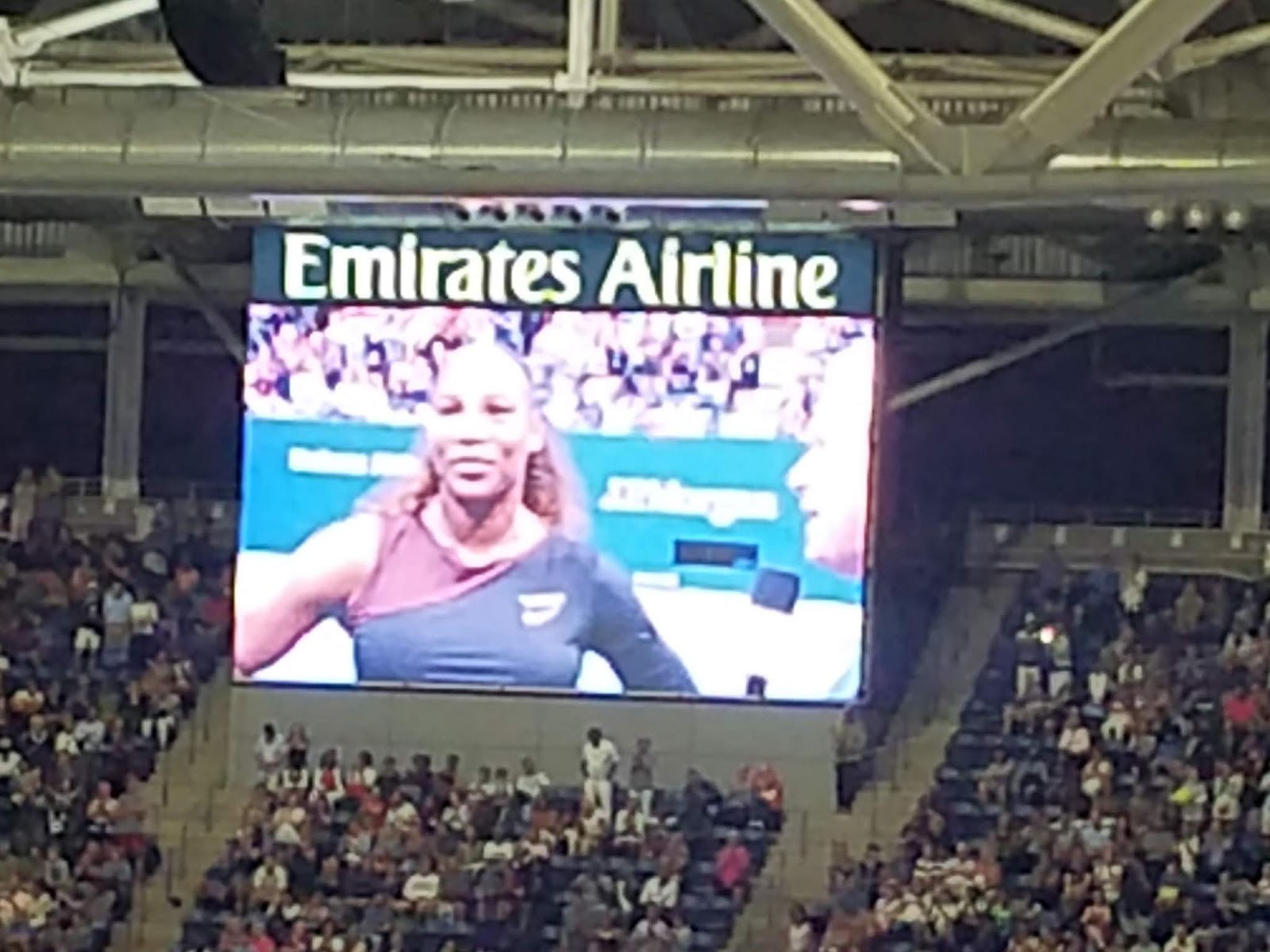
 Serena reacts to her victory on the Jumbotron
 Serena packs up after her victory over Venus
Rafael Nadal faces the international press after his four hour-twenty three minute victory over Karen Kachanov-photos Dwight Casimere

Flushing, NY--If Serena William's victory over her sister in last week's match at the US Open, she is well on her way to her 10th straight US Open quarterfinal. That fact was confirmed by her defeat of Estonian Kaia Kanepi on Sunday. Kanji knocked over No.1 seed Simona Halep in the first round. She will next face Karolina Pliskova of the Czech Republic, who was the last player to beat her at the U.S. Open in the semifinals in 2016.

What was expected to be a Battle Royale turned out to be nothing more than a tepid tennis clinic, in which Serena showed off her superlative serve toss and ability rack up multiple aces.  The only hint at drama was a turned ankle after the first set, that seemed to do little to dampen her capabilities. Venus rocketed the occasional shot past Serena to just inside the baseline, just to let her know she's still the big sister.

Serena called the contest "my best match." Sister Venus also said it was the "best match (Serena has) ever played against me. She played so well, I never got to really touch any balls. When your opponent plays like that, it's not really anything to be upset about."

The fact of the Williams sisters playing each other is nothing new. They've competed against each other over the past 20 years. Serena, who gave birth to daughter Alexis last September commented "It's by far the best match I ever played against her in forever."

By contrast, the four hour, 23 minute match between Rafael Nadal and Karen Kachanov was a barn-burner. It was the longest match of this year's US Open and the longest Nadal has ever played at Flushing Meadows. "These matches test you, but they only make you stronger," Nadal said of the contest in a post-match news conference. " A made a few mistakes at the net, but I was able to recover and outlast him."

Asked how the match will affect his thinking in competitions going forward, "I know that I am strong and able to compete at the highest level, even when I am tested."

Meanwhile, the quarterfinals are a virtual showcase for the rising crop of black tennis superstars, especially in the women's category, with defending champion Sloane Stephens and her 2017 US Open opponent Madison Keys, in the running, along with Serena and relative newcomer Naomi Osaka, all in the quarterfinals.

Thursday, August 9, 2018

PAT METHENY HEADLINES 2018 NEWPORT JAZZ FESTIVAL WITH INSPIRED PERFORMANCE

64TH NEWPORT JAZZ FESTIVAL A TRIBUTE TO OLD LIONS, NEW TIGERS

 Dwight Casimere with Cecile McLorin Salvant following her blistering performance with Artemis (below) Artemis ensemble Cecile McClorin Savant, Melissa Aldana, sax, Noriko Ueda, Bass, Anat Cohen, woodwinds,  Ingrid Jensen, trumpet -not shown, Allison Miller-percussion

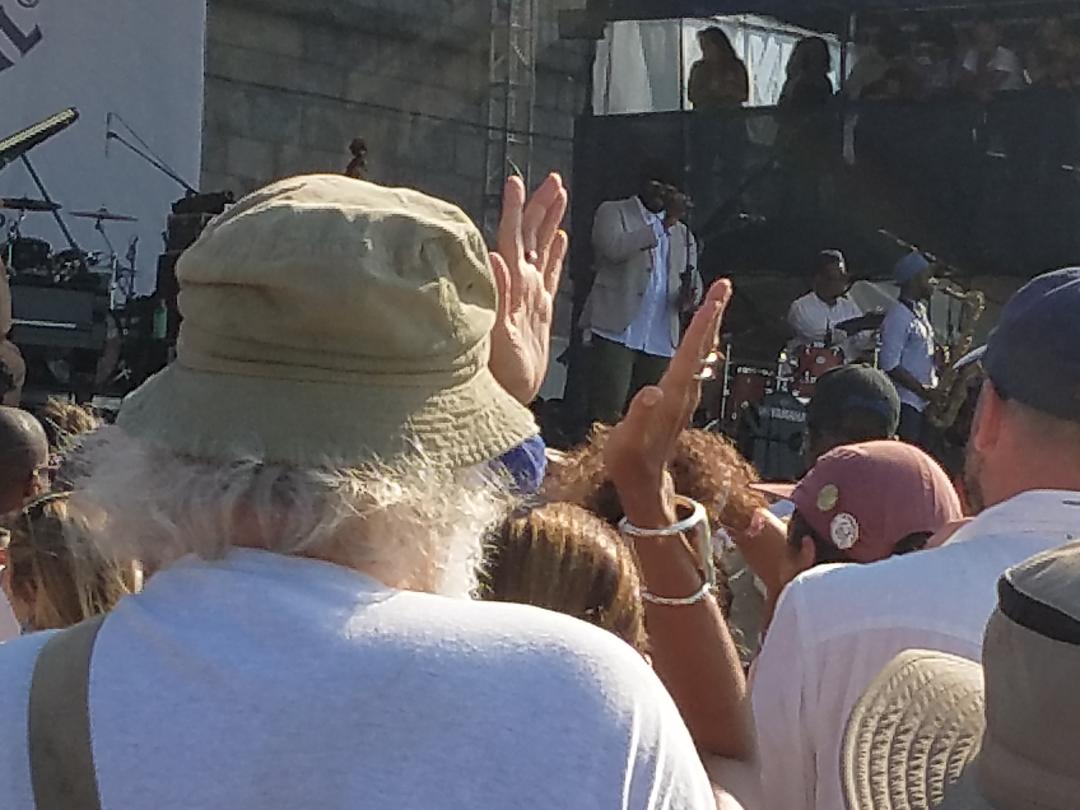
 Charles Lloyd thrills the rain-soaked crowd on Saturday with his New Quartet

 Charles Lloyd shows his multi-faceted talents on the flute
 Pat Metheny plays his eponymous hit composition James on Opening Night at the International Tennis Hall of Fame, site of the first Newport Jazz Festival in 1954
 Charles Lloyd evokes the spirit of sax legends John Coltrane, Coleman Hawkins, and Lester Young
 Dwight The Connoisseur at the Newport Jazz Festival Fort Stage overlooking Newport Harbor
 Cecile McLorin Salvant sings Bille Holiday's  Fine and Mellow
Spectacular sunshine rewarded concert-goers for the final day of the festival

 Gregory Porter brings down the house with his original composition Take Me To The Alley


by Dwight Casimere


Like a painter digging deep into his palette of oils and water colors, newly-appointed Artistic Director Christian McBride extracted a 2018 Newport Jazz Festival program that showcased the full depth and breadth of the musical genre in a kaleidoscope of colors. Legendary lions bellowed from the caverns of time; the guitar great Pat Metheny on Opening Night at the International Tennis Hall of Fame, site of the original festival in 1954, and Charles Lloyd, celebrating his 80th birthday in a trio of settings, and rising stars such as teen wunderkind Matthew Whitaker and the scintillating baritone Jose James streamed across the Newport Bay sky like so many multi-colored musical fireworks. This was no artifice, but the referencing of a skilled hand presenting a weekend calendar of artists designed to please both the seasoned aficionado and the jazz neophyte alike.

Guitar master and musical icon Pat Metheny began the Opening Night concert on the International Tennis Hall of Fame stage on a contemplative note, expressively improvising on solo guitar before launching into one of the most inspired sets witnessed by this reviewer. He was backed by a stellar ensemble of celebrated composer/musicians in their own right (Antonio Sanchez, percussion, Grammy Award Winner, Best Soundtrack and Golden Globe nominee for the soundtrack to the Oscar-winning film Birdman in 2014; Malaysian/Australian composer Linda May Han Oh doing a soaring turn on Bass and British pianist and composer Gwilyn Simcock with his surging improvisations). Metheny closed the set with a solo turn on his custom made Pikasso acoustic guitar. He returned to perform the next day on the main stage in driving rain, yet he delivered an electrifying set that rivaled the hurricane level wind and rain with his intensity. 

At Opening Night, the esteemed young baritone Jose James appeared inexplicably in a retro getup reminiscent of either Jimi Hendrix or Prince. The unfathomable wardrobe reference appeared to have little to do with the subject of his concert, a musical tribute to composer and singing artist Bill Withers. It was particularly baffling since through his entire career as a performer, Withers eschewed any trappings of the popular recording industry. In fact, his memorable, quietly soulful hits (Grandma's Hands, Hello, Like Before, among many) were, by design the very antithesis of the commercial pop/funk/soul that dominated the music scene at the height of his career. 

After a somewhat faltering start, James's gained his vocal footing and his performance acumen accelerate. He gave a blistering performance of Grandma's Hands,perhaps Wither's most recognizable tune, and proceeded to dig his considerable vocal chops deep into Wither's contemplative lament, Hello, Like Before. This is what everyone came to see, not the tepid nonsense he started out with. Sadly, there was little in the way of a narrative thread throughout to she any light on a performer whose career seemed to ebb before most of today's concert-goers were even born. I would have like to have heard more about Bill Withers and his unlikely rise to fame, and the genesis of his poignant and highly personal songs. Yet, James managed, just for a moment,to make time stand still, casting a hush over the audience, with a watchful Mars, glittering high in the nighttime sky. 

The following day's stormy weather did little to dampen audience enthusiasm or the talents of the brilliant performers on multiple stages at the festival on the isle of Fort Adams. 


Pat Methany returned to perform the next day on the main Fort Stage in driving rain, yet he delivered an electrifying set that rivaled the hurricane level wind and rain with his intensity.

Vocalist and saxophonist Grace Kelly kept things moving swimmingly (pardon the pun) in the shelter of the Quad stage, paying musical tribute to festival Artistic Director Christian McBride in a stunning display of vocalize and launching into her own uniquely refreshing brand of  jazz fusion which she proclaimed was inspired by a film on female superheroes. Musically, she can claim the same encomium for herself.

Metheny and company perservered on the Fort Stage overlooking a roilling Newport Bay. Just as he had ended his Hall of Fame concert with a pensive evocation on the solo acoustic guitar, the aforementioned custom built 42 -string Pikasso guitar. His free-wheeling, highly imaginative and emotive strumming left no doubt that audience members were in the thrall of a true modern musical master. Those who hung with him through the rain soaked afternoon were richly rewarded for their sufferings. Metheny's composition Bright Size Life was perhaps a harbinger of things to come under the following day's shimmering summer skies.

Artemis, the all-female musical ensemble led by brilliant pianist and composer Renee Rosnes featured Melissa Aldana on Saxophone, Anat Cohen, clarinet and reeds, Noriko Ueda, Bass, Ingrid Jensen, trumpet and Allison Miller on explosive percussion. The icing on this all-female celebratory cake was a vocally superlative Cecile McLorin Salvant, who proved with her artful phrasing and towering jazz vocal improvisations, that the human voice is just as potent a musical instrument as any of those assembled onstage. The group's collective effort on Monk's Brilliant Corners, set the tone for the performance under blazingly beautiful summer skies, with the ambiance of boats in the harbor serving as the backdrop to a delightfully swaying capacity crowd. 

Savant, looking slim and lovely in a simple white summer linen dress, laid claim to her own musical legacy, with a tribute to Billie Holiday, singing Fine and Mellow, a simile that can easily be applied to Ms. Salvant.  

Artemis similarly gave musical flight with takes on the Beatles (Fool On The Hill) and an appropriately innovative take on Stevie Wonder's If It's Magic, creating a musical alchemy all their own. 

Eclectic saxophone and reed legend Charles Lloyd celebrated his 80th birthday in three separate incarnations. In his second outing on the Fort Stage in driving rain, he presented a riveting set highlighting his New Quartet, the ground-breaking pianist and music historian Jason Moran, Bassist Reuben Rogers and drummer Eric Harland. Lloyd, a devout Yoga practitioner, contorted his tall, lean form about the stage as he wove his unique musical tapestry with threads of past icons, Prez, Hawk and Trane, with his own brand of musical mysticism and flights of fancy. Moran was the commander of the ensemble's ship, keeping apace with the quixotic twists and turns of Lloyd's flashes of current genius and fleet ing remembrance. No other saxophonist, save the great John Coltrane himself, were he still in corporeal form, could have given such an all-encompassing and thoroughly enthralling career recital.

Avant-garde vocalize high priestess Lucinda Williams lent her whalloping yelps and free-form scat to add a proper note of unabashed gaiety to Charles Lloyd's 80th Birthday Celebration. It was the equivalent of a New Orleans Second Line, Delta Blues wail, and Primal Scream, all combined with the forces of an intergalactic band playing celestial instruments!

Gregory Porter lent his stentorian baritone to the afternoon, also on the Fort Stage, with some uptempo recreations of his many original hits; Take Me To The Alley, among the most notable.

The Festival ended on a decided note of funk, with the explosive George Clinton and Parliament Funkadelic bringing the entire Fort Stage crowd to their feet for a swinging, Funk and Hip Hop crescendo. Only one sad note marred the afternoon, Clinton's announcement of his retirement from the performance stage in the coming year. Not a very bright prospect for music lovers in the New Year. When Clinton played Chicago's Navy Pier New Year's celebration a few years ago. The night ended with post-performance fireworks. That would have been a fitting sendoff for Clinton and the Funkadelic at this year's Newport, considering his impending retirement and the likely prospect that he will never play the festival again. One could hear the musical celebration clear across the Bay in Newport Harbor, following the Ferry Ride to Bowen's Wharf.  Yeah. There should have been fireworks for this one. George Clinton and the crowd would have loved it.