Sunday, November 27, 2011

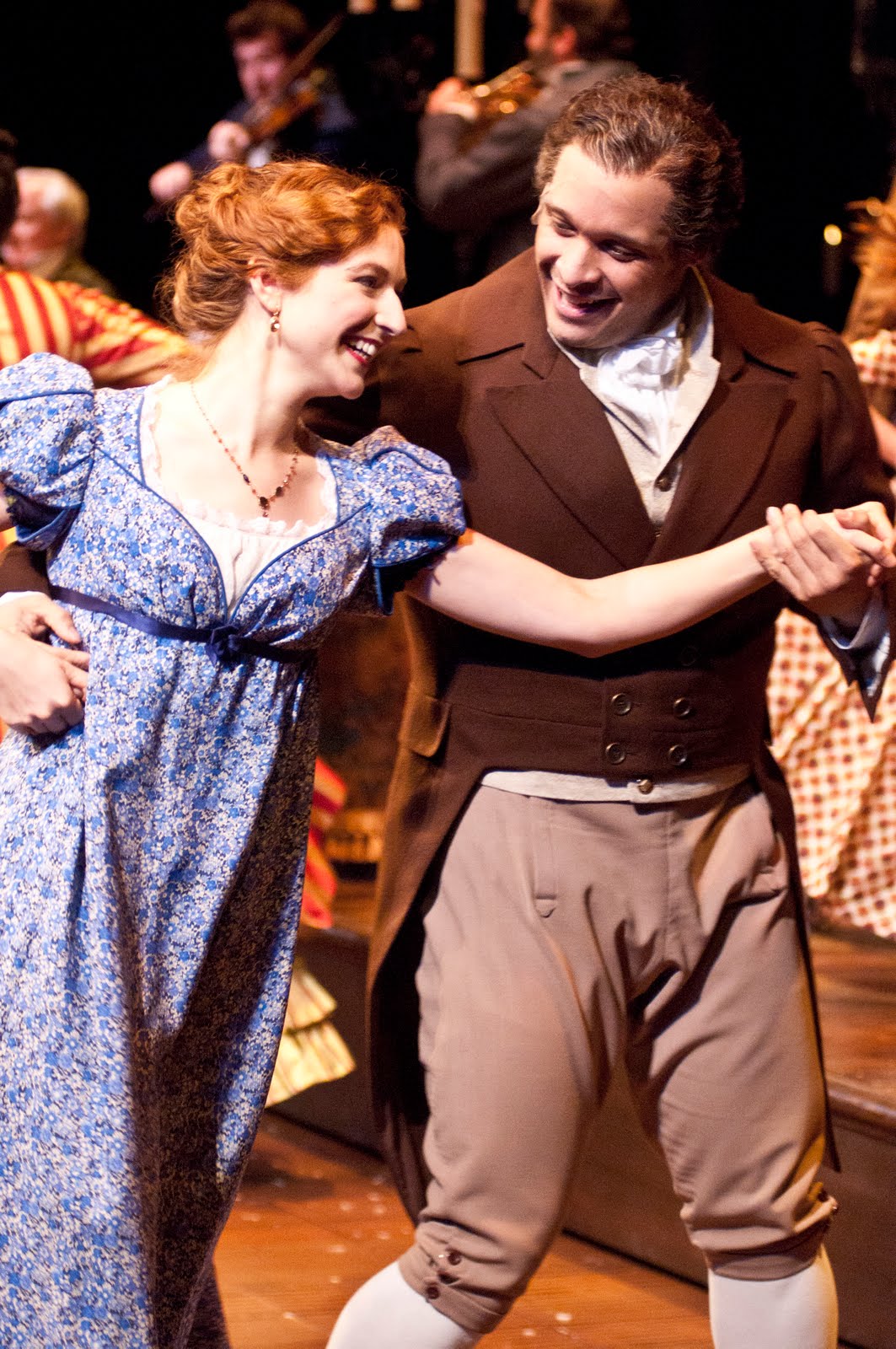
Goodman A Christmas Carol delivers lean, poignant Holiday "punch"


Goodman A Christmas Carol a lean, poignant Holiday “punch”

By Dwight Casimere

Photos: Dean LaPraire/ Goodman Theatre

Larry Yando is back as Ebenezer Scrooge in the Goodman Theatre’s 34th annual production of Charles Dickens’ A Christmas Carol, and all is right with the world. Or, as the character Tiny Tim (played charmingly by nine-year-old Roni Akurati), would say, “God Bless Us. Everyone!”

As conceived by Goodman Theatre Associate Producer Steve Scott, who makes his fourth turn at the helm since 2007, this is a leaner and more poignant “Carol” than years past. The set is minimal, with a bleak, snow-covered forest serving as the backdrop rather than the traditional hustle and bustle of a village square. The actors, fulcromed by Yando’s spot-on, eloquent performance, hone in on the sociological and psychological underpinnings of Dickens’s timeless preachments on self-righteous selfishness and the saving grace of love, kindness and goodwill toward all mankind.

The premise for “A Christmas Carol” is set out from the opening line. “Marley was dead,” the story begins, spoken from the mouth of a member of the street chorus at the opening curtain and repeated by Ebenezer Scrooge in the establishing scene between he and the hapless Bob Cratchit (Ron Rains, returning in his fifth year in the role). It is Marley’s Ghost (a nimble and frightful Nathan Hosner) that haunts Scrooge from the face of his doorknocker to the sanctity of his bedchamber. He is warned that he will be visited by three ghosts- the specters of his Christmases past, present and future. Of the three, it is Christmas Present (Penelope Walker) who proves to be the most luminous and telling in her portrayal. She is absolutely brilliant!

There are sterling performances throughout. Joe Minoso, with his eloquent manner and stentorian voice is compelling as Scrooge’s nephew, Fred. Ora Jones is effusive as Mrs. Fezziwig and Karen Janes Woditsch gives emotional depth to the long-suffering character of Mrs. Cratchit. Ron Rains is an expert at comedic timing in the role of Bob Cratchit.

The onstage musicians, particularly the nimble-fingered “fiddle” player, add a sparkle to the proceedings early on. One gem of a scene is the dance at Fezziwig’s warehouse. Production Stage Manager Alden Vasquez and Stage Manager Jamie Wolfe get deserved credit for the execution of this exceptional production with Set Design by Todd Rosenthal and excellent Costume Design by Heidi Sue McMath, who captured the taciturn look of the Dickens era exactly. Sound Design by Richard Woodbury and Lighting Design by Robert Christen worked hand-in-hand to emphasize the dramatic arc of the story with precision. Original Music Composed by Andrew Hansen told the story in concert with the superb dialogue in the story Adapted by Tom Creamer for the Goodman stage. This is a top-flight production that brings the social message of the Christmas Holiday home in an entertaining, yet truthful manner. In light of the Occupy Wall Street demonstrations that are sweeping the country and the uncertainty of the economy this Holiday Season, A Christmas Carol presents a sobering message in a wholly entertaining and delightful manner that has become a staple among Holiday family experiences. For tickets and information, visit GoodmanTheatre.org.

Broadway In Chicago: Memphis-a hi energy look at racism and good ol' Rock 'N Roll


Broadway in Chicago: Memphis-a look at race, sex through lens of good ol’ Rock N’ Roll

by Dwight Casimere

Photos courtesy Broadway In Chicago

Memphis is a high-stepping, high octane look at the Fabulous ‘50s world of Rock ‘N Roll and Race Music through the eyes of a hard-charging, take no prisoners white DJ, Huey (Bryan Fenkart), who becomes the host of a local Dick Clark American Bandstand-like dance show, only his show features primarily black dancers and “Race Music,” the moniker given to black rhythm and blues which white artists, such as Elvis, exploited to national prominence.

Huey falls in love with Felicia (Felicia Boswell), one of the singer/dancers on his show, and therein lies the heavy subtext to this otherwise light-hearted look at the seminal music of the”Memphis Sound” Rhythm and Blues era.

Memphis garnered a Tony Award for Best Musical last year, and it’s easy to see why. The music is infectious. It has you dancing in your seat and wishing you could kick your feet in the air and do cartwheels, just like the high-spirited Marge and Gower Champion-styled dancers.

Felicia Boswell is a tsunami of vocal talent. She begs the question, “why haven’t I heard of her before!?” Her voice is extraordinary. Her sensuality and earthiness make her an irresistible talent.

The Ensemble is electrifying as is the Memphis Band under Conductor/Keyboardist Alvin Hough, Jr. whose musicians sounds just like the legendary Stax Records studio (originally Satellite Records) band of old.

The show gets a little heavy with the melodrama at times, but the high-spirited music and dancing save the day. Through December 4 at the Cadillac Palace Theatre, Chicago. Visit www.broadwayinchicago.com for tickets and show times.

Met Live HD Satyagraha a dazzling, epic spectacle


MOVIES: MET LIVE HD SATYAGRAHA

By Dwight Casimere
Photos: Ken Howard/Metropolitan Opera

Richard Croft as Gandhi with image of Dr. King in background
Mary Phillips as Mrs. Alexander
Satyagraha sets and puppets by Julian Crouch
Met Opera bass/baritone star Eric Owens as backstage host/interviewer
The Metropolitan Opera House, Lincoln Center, New York City


New York-Giant puppets that dwarf singers onstage. A mesmerizing score by a groundbreaking composer. Lyrics in an often-untranslatable “dead language,” with limited subtitles. Dazzling visuals that include flying Hindu gods and shadowy representations of historic icons such as Leo Tolstoy all played against the sweeping panorama of the fight against racial injustice in South Africa. That, in a paragraph is the synopsis of Satyagraha, Philip Glass’s epic recitative of Mohandas KJ. Gandhi’s, the Father of the Indian nation, and his fight against South Africa’s policies of racialism.

“This answers the question of ‘why do we do new productions?’” creator Philip Glass told backstage interviewer, rising Met star, bass/baritone Eric Owens, during the intermission of the Met’s recent Live in HD transmission in movie theatres around the globe. Owens will portray Alberich in Wagner’s Gotterdammerung in the Met Live HD transmission Saturday, February 11 at 12 noon Eastern Time. The performance runs 6 hours, 24 minutes. Many theatres are offering lunch/theatre ticket packages, so please check your local theatre listings or online for details.

An Encore Performance of Satyagraha will be shown in select theatres on Wednesday, December 7, 2011 at 6:30pm in all time zones. Please note that not all theatres that show Met Live HD transmissions will present an encore showing. Check local theatre listings or visit fathomevents.com or metopera.org.

“The answer is that new productions give an existing opera new life,” Glass said emphatically.

"The last time we did a "new" production was in 1991, before the official end of apartheid. Now it's almost 2012, and a far different time altogether. We had to do something that not only looked at Gandhi's life through the long lens of history, but also in a way that would make it relevant to audiences today who may not have an immediate memory or familiarity with any of the events that transpired before."

Visually, Satyagraha is opulent. Sanskrit supertitles are projected onto the rear of the stage as the orchestra plays Glass’s hypnotic score, expertly conducted by Dante Anzolini. Supertitles and back-of-the-seat subtitles translations are discarded for Satyagraha. Instead, the text by Constance DeJong, as adapted from the Bhagavad-Gita -Gita, is sung entirely in Sanskrit, an ancient language that precedes Biblical times. Subtitles are projected only occasionally on the wood and corrugated iron sets, more as thematic punctuations rather than actual translations. Staging, as directed by Phelim McDermott with stunning sets and puppet designs by Julian Crouch underscore the opera’s setting as more an extension of Gandhi’s mind during prolonged meditation, rather than a recounting of historical fact.

Dazzling visual components, augmented by giant puppets, wall-sized video projections and streams of properties representing reams of newsprint and the undulating waves of water were all created by the Skills Ensemble team members Phil Eddolls, Carlie Folorunsho, Alex Harvey, Nick Haverson, Tina Koch, Charlie Llewllyn-Smith, Vic Llewellyn, Charlotte Mooney, Kumar Muniandy, Caroline Partridge, Rajha Shakiry and Rob Thirtle. Team mebers Rob Thrtle and Philip Eddolls discussed their efforts with backstage host Owens. "What we created, visually, were the touchstones of Ghandi's life, which are not necessarily referred to in the text of the opera, but are integral to the story of his life," Eddolls said. "We see representations of the major influences of Gandhi’s life, including his past present and future in terms of the god’s, as represented in the Bhagavad-Gita, Leo Tolstoy, the philosophical leader of the Bolshevik Revolution in Russia, and Dr. Martin Luther King, Jr., who channeled Gandhi’s theory of non-violent resistance into the marches of Civil Rights Movement."

These and other points were well brought out by Mr. Owens in his backstage interviews and commentary. Owens distinguished himself as a host and interviewer by his ability to think nimbly on his feet, not having to scramble through note cards or look over his subject’s shoulder for a teleprompter. He was able to ask insightful questions because of his innate knowledge of opera and he was also able to elicit illuminating responses from the singers due to his empathy toward his fellow Met opera artists.

All of the singers performed spectacularly, particularly tenor Richard Croft as Gandhi, who performed Glass’s demanding score with elegance and precision throughout. His feat was further magnified by the fact that he is virtually onstage throughout the opera. Maestro McDermott similarly distinguished himself along with the Met Opera Orchestra with their ability to navigate the shifting tempi and kaleidoscopic tonality and moods of Glass’s mesmerizing score.

An illuminating historical perspective on Gandhi’s life and work and the historical facts behind his struggle for racial equality and equitable treatment of Indian mine workers in South Africa, further sets the factual background of Glass’s epic work. The producers of the segment were Elena Park, Kathy Doughty and Doug Graves, who addressed the audience in a videotaped interview. These and other video segments and interviews are the exclusive purvey or Met Live in HD audiences and further amplify the value of the price of admission.

Sunday, November 20, 2011

Haitink in impeccable performance of Haydn and Bruckner at NY Phil


Bernard Haitink brings dignity, restraint to Haydn and Bruckner at NY Philharmonic

By Dwight Casimere

Photo 1 Matthew Dine for the New York Philharmonic

New York-Guest Conductor Bernard Haitink received a rousing ovation as he approached the podium at Avery Fisher Hall to conduct a program of Haydn’s Symphony No. 96 in D major and Bruckner’s Symphony No. 7 in E major with the New York Philharmonic Orchestra.

Maestro Haitink had not conducted the orchestra since 1978, so the pent up enthusiasm was warranted. Those who expressed it were certainly rewarded by a program that showed both dignity and restraint in a very polished performance. This was Haitink at his best; conducting a seasoned, world-class orchestra in works that have become cornerstones of his repertory.

Haydn was the Jay Zee of London when he presented his Symphony No. 96. It was nicknamed the “Miracle Symphony” because, supposedly, a chandelier crashed in the concert hall at the premiere and, miraculously, no one was injured. His arrival in London was associated with the kind of celebrity we see recorded on TMZ today. His publicist took him on rounds of the London newspapers for interviews and he was the toast of an endless string of parties and dinners. London’s megatropolis atmosphere, even in the 1790s, was a long way from the gentility of the Esterhazy court of Vienna. Even in those days, the court’s arts programs were subject to economic cutbacks caused by a budget crunch due to political successions, leaving Haydn footloose and fancy-free to explore other climes. Vienna’s loss was London’s gain!

Maestro Haitink showed this gem of a symphony in all its multi-faceted glory. A slimmed down “Classical” Philharmonic played the music under his direction as if it were intuitive. His every move elicited just the right tempo or shading of orchestral color. A lightness of being evinced from the Menuetto and Trio. The Finale: Vivace (assai) was a showcase for the sylvan strings and burnished cellos and violas.

It all came to a refreshing, precise conclusion that affirmed the intellectual crispness of thinking that went into Haitink’s measured interpretation of this beautifully conceived work.

The last time I heard Bruckner’s Symphony No. 7, it was under Mr. Haitink’s baton, leading the Chicago Symphony Orchestra, a work he recently recorded with that esteemed body. (Haitink and the CSO won a Grammy Award in 2009 for Best Orchestral Performances for Shostakovich’s Symphony No. 4, while serving as the body’s Principal Conductor) To call his rendition of the Bruckner with the New York Philharmonic mesmerizing is an understatement.

His approach was transfixing from beginning to end. The Adagio, in particular, showed his unique ability to approach weighty subject matter with restraint. His precision elicited the type of dramatic buildup that made the ensuing Scherzo appear to dazzle like a shooting star. There were some exquisite solos from the flutes and oboes as well. The strings shimmered with intensity as the timpani rang mightily leading to the rapturous Finale.

Orchestre Revolutionnaire et Romantique explores Beethoven's "Heroic" ideals


Carnegie Hall tenure ends on "Heroic" note

By Dwight Casimere


Photos:

Sir John Eliot Gardiner conducts

An early French horn

A Baroque trumpet


New York---Sir John Eliot Gardiner is considered one of the guiding lights of the early music revival. As founder of both the Orchestre Revolutionnaire et Romantique, and the English Baroque Soloists, his concerts and more than 250 recordings have earned him the highest honors. In addition to his knighthood, he is an Honorary Fellow of King’s College, London, and the Royal Academy of Music, which awarded him the prestigious Bach Prize in 2008.

In the last of two concerts at Carnegie Hall, he presented a program that probed the theoretical underpinnings of Beethoven’s music in the wake of his early, formative years. The Overture to Die Geschopfe des Prometheus (The Creatures of Prometheus) is a work he composed to accompany a ballet by choreographer Salvatore Vigano in 1800. The work depicts the story of the Greek Titan Prometheus, who creates humans out of clay and imbues them with knowledge of the arts and sciences. This idea fascinated Beethoven and informed his later theories on society and politics of his day.

The second work in the program, the Symphony No. 4 is, stylistically, one of the composer’s most refined. It employs a structure that he would use in several of its later works. The contrast between slow and fast passages, and the dark, minor modes that would emerge into bright, major-key finales would become Beethoven’s hallmark.

Finally, the Symphony No. 3 in E-flat Major, the “Eroica” (Heroic), is among his most dazzling. Originally dedicated to Napoleon, the composer tore up the title page when he learned that Napoleon had declared himself “emperor.” Beethoven despaired that his fallen hero would “now trample on the rights of man” as did every despot before him.

It is this profound sense of history that Sir John Eliot Gardiner brought to the Perelman Stage as he conducted his energetic ensemble of period instrument players at Carnegie Hall.

The tempos he created for the Prometheus were aggressive, without being overly hurried. There was ample allowance for the trumpets to ring forth in the dramatic exclamation of the opening chords. Zeus’s ‘thunderstorm’ when he exacts punishment against Prometheus for stealing the gift of fire and giving it to the mortal beings he created, is one of the highlights of this stirring performance that showcased the superb partnering of the string sections and the ringing percussion, in the form of perfectly tuned timpani.

One of the evening’s great mysteries was the location of the timpani player and his instruments. It was revealed at intermission that he was seated rather low, behind the riser that held the violas and second violins. He eschewed the break enjoyed by the other musicians during the interval to tune his well-polished drums. The superb clarity of his sound affirmed the good result of his labors.

Horns and trumpets once again dominated the jubilant finale to the Symphony No. 4. However, it was the Eroica that showed the true mettle of this superb ensemble. Every member of the orchestra gave his or her all in a performance that matched in energy the ‘heroic’ title of the symphony. The elegiac Marcia funebre(funeral march): Adagio assai set up the dramatic contrast for the explosive Scherzo (fast movement) and the blazing finale, heralded by the flutes (here, truly made of wood or “woodwinds,” not the shiny silver and brass modern flutes we’re accustomed to seeing) and those incendiary valveless trumpets that are a marvel to behold. Similarly valveless horns also made their forceful presence known with some exquisite playing.

Beethoven ends the Eroica with a theme he had presented in the earlier “Prometheus” Overture. Maestro Gardiner emphasizes that point with great aplomb, giving a performance that showcased his and his orchestra’s versatility and mastery of the music that defined the turning point between Classic and Romantic music.

Orchestre Revolutionnaire et Romantique does Beethoven justice with period instruments


Orchestre Revolutionnaire et Romantique: Beethoven as he was meant to be heard

By Dwight Casimere

New York—John Eliot Gardiner and his Orchestre Revolutionnaire et Romantique swept into the Isaac Stern Auditorium of Carnegie Hall on Prometheus’s chariot in a two-day celebration of the genius of Ludwig von Beethoven. Playing period instruments, not unlike the ones the great Maestro would have encountered in his day, the orchestra injected new life into some of the most performed music of the modern concert stage with a vitality that made it seem as if the scores had just been written. This is Beethoven as he might have heard it, were it not for the advancing deafness that historians say he suffered from.

Gardiner modeled is ensemble after the French orchestra and the Leipzig Gewandhaus, the primary proponents of Beethoven’s music after his death. Their sense of ‘divine mission’ permeates everything they play. Each of the instrumentalists plays as if his or her life depended upon it. Their fervor is best exemplified by the intense expression of rapture on the face and the stream of sweat from the tousle-haired brow of the lead cellist in the front row, who seemed to be in the throes of rapture with each furious stroke of his bow.

Overture to Egmont was part of a set of compositions written as incidental music for the 1787 play by Goethe, which tells the story of the Flemish Martyr Count Egmont, who sacrificed his life so that his fellow citizens might be spared genocide at the hands of the occupying Spanish. Gardiner and his eager ensemble, which contains quite a few exceptional female members, presented it with all of the heroic thunder it deserved. The horns, distinctive from their modern counterparts because they are valveless, made a stately declaration. There was one tiny flutter from one of the horns going into the eight bars leading to the finale, but the rest was spot on.

Symphony No. 7 was a study in exuberance. Maestro Gardiner took the dance-like rhythmic notations of the Allegro con brio to heart, making side-to-side steps approaching the Electric Slide.

His handling of Beethoven’s Symphony No. 5 made the case for the primacy of period instruments. From the opening bars, which contain the most familiar musical phrase of all time, the sense of exilaration permeated the air. The rounded, burnished sound of the brass and woodwinds made the phrasing of the Second Movement, Andante con moto, seem even more fraught with dramatic tension. Think the Royal Lipizzaner of the Spanish Riding School in perfect formation in a stately gait around the arena. The Allegro was full of fireworks as Gardiner dug his heels into their ribs, urging them to full gallop, the bracing wind flying through their collective mane.

Friday, November 18, 2011

Bernard Haitink, New York Philharmonic paint vivid portraits of Strauss's Don Quixote and Beethoven's Pastorale


by Dwight Casimere


NEW YORK- I last saw the esteemed conductor, Bernard Haitink in a two-week residency with the Chicago Symphony Orchestra, conducting programs of Mahler’s Fourth Symphony and Haydn’s Creation. Both performances stand as monuments to his greatness.

With great anticipation, I rushed to Avery Fisher Hall in Lincoln Center to hear him Guest Conduct the New York Philharmonic in Richard Strauss’s illustrious tone poem, Don Quixote (Introduction, Theme with Variations, and Finale) and Beethoven’s Symphony No. 6, Pastoral. The evening could not have been more sublime.

At 82 years of age, Maestro Haitink displays the type of economy of movement and interpretation that eschews the flashy and unnecessary. All pretenses are stripped away and only that which is essential to the mission at hand is introduced. Entrances and exits are clean and crisp. Tempos are precise and unhurried. Nuances in tonal color and balance are carefully observed and inner voices of instrumental embellishments and subtleties are brought to the fore with utmost clarity. In short, you become aware of things in the most often played symphonies, such as Beethoven’s Pastoral, that you had never noticed before.

Strauss’s Don Quixote started simply enough, with the orchestra’s Principal Cellist Carter Brey and Principal Viola Cynthia Phelps as soloists. Both the conductor and soloists gained intensity as the work recounted the misguided, but well-intentioned travails of Cervantes’s beloved knight-errant and his chivalrous missteps, along with his faithful sidekick, Sancho Panza. Ms. Phelps and Mr. Brey indulged in a bracing point, counter-point, particularly in the bracing Variation IX (Fast and Stormy). The Wind Machine, used to depict Don Quixote and Sancho in imaginary flight across the sky in Variation VII (A Bit More Calm than the Preceding), is used sparingly, but effectively.

Maestro Haitink brings it all to a peaceful conclusion, with dreamlike serenity.

As energetic as the Don Quixote was at times, Maestro Haitink and the New York Philharmonic created an atmosphere of verdant hills and fertile valleys that belie what history tells us was the tumult of the composer’s personal life and the political and social upheaval of his time.

In 1808, when the majority of the Pastoral was composed, Beethoven was in the advanced stages of hearing loss and his beloved Vienna was a hotbed of unrest. The composer would escape often to the countryside to the homes of wealthy friends and benefactors. It was out of these forays into the peaceful refuge of nature that the Pastoral was born. Themes, like blossoming flowers appear and dissipate as new life emerges among the violas, cellos and woodwinds. Haitink carefully controlled the entrances and exits of these subtle voices, to achieve an exquisite equipoise of sound. A smoldering intensity dominated the Allegro: Thunderstorm. Flutes and trumpets played eloquently in the Allegretto: Shepherd’s Song.