Reviewed by Dwight Casimere August 2, 2013
NEW YORK---Grammy Award-winning piano virtuoso Emanuel Ax rendered a precise elucidation of Beethoven's Piano Concerto No. 2 in B-flat major, with British violinist and conductor Andrew Manze on the podium with the Mostly Mozart Festival Orchestra at Lincoln Center.
In a program of compositional "heavyweights" that more resembled an evening at The Proms or at the Royal Festival Hall in London, no doubt familiar territory to Manze, this was a night that promised much and, indeed, delivered on all counts.
Rather than featuring anything by Mozart, as one would expect at a Mozart festival, the night's program was all about Beethoven, with his highly evocative Symphony No. 6, "Pastoral," to conclude the evening after the interval. Emanuel Ax began by performing Beethoven's Piano Concerto No. 2 with the artist playing Beethoven's original cadenzas. Ax's reading of this oft-played piece was precise, but layered with emotion. The arpeggios and sustained trills of the left hand were as crisp and brilliant as points of light in the constellations in the opening Allegro con brio. The Adagio showed Ax's brilliant command of Beethoven's towering vision of the work, with both he and Manze leaning into the work with depth of feeling, without going overboard into Schmaltz. The concluding Rondo: Molto allegro saw Emanuel and Manze kick things into high gear, while retaining a modicum of constraint that allowed the contrapuntal themes repeated by Beethoven from the earlier movements, to ring through the intricate netting of new motifs that were sprinkled throughout this delightfully exuberant masterpiece.
Andrew Manze's interpretation of the Symphony No. 6, "Pastoral" was true to
Beethoven's vision of the piece as, in the composer's words, "more an expression of feeling than painting." Although one of his most unabashedly programmatic works, it still stands as one of Beethoven's great achievements of structure and daring content in symphonic form. Depicting a walk in the country, the composer's encounter with a group of dancing peasants, a quiet reflective moment by a brook, and then his survival of a raging storm and a concluding song of thanksgiving, the much-beloved "Shepherd's hymn," Manze and the festival orchestra practically danced through this riveting piece. Tempos were bright and unhurried. Manze was careful to bring out the composer's underlying themes, while letting melodic configurations soar above the dense orchestrations with majesty. The Shepherd's hymn read like a benediction of hope and redemption that resonated beyond the work's conclusion.
Saturday, August 3, 2013

Friday, August 2, 2013
Lincoln Center Presents Mostly Mozart with a Hefty Dose of Beethoven and Debussy
Reviewed by Dwight Casimere July 31, 2013
NEW YORK--Music audiences never seem to tire of the music of Mozart and Beethoven. Place the names of any of the "big three," Mozart, Beethoven and Bach, on a symphonic program, and its almost guaranteed to sell tickets. Such was the case with the Opening Night programs of Lincoln Center's Mostly Mozart Festival July 27-August 24, 2013. This year's festival features the music of Ludwig Van Beethoven whose musical genius was said to have been inspired and molded by Mozart's towering presence.
Now just a few years shy of celebrating a half century of existence, this year's edition of the Mostly Mozart Festival is blessed with the return of its spirited Music Director, the esteemed French conductor Louis Langree', and the collaboration of two outstanding soloists, the voluptuously voiced mezzo-soprano Alice Coote in two of Mozart's dramatic arias, and fellow Frenchman Jean-Efflam Bavouzet, in Beethoven's Piano Concerto No.4 in G major.
Adding to the aura of excitement was the innovation of thrusting the stage out into the audience seating area and surrounding the orchestra with seating onstage, which made for both an illusion of intimacy in the vast expanse of Avery Fisher Hall and a rare, if at times, overly revealing display of the Mostly Mozart Orchestra's considerable strengths and forgivable weaknesses.
Conductor Langree' and the orchestra dispatched the opening selection, Beethoven's Overture to the tragic play Coriolan, with ease and authority. Langree' brought out the flashier elements of this short (8 mnutes) but lively piece, by punctuating the high notes of the horn section and the rumbling lines of the bass. The contrast made for a thrilling performance.
The lovely Alice Coote brought a smooth, luscious approach to Mozart's concert aria Ch' io mis scordi di te...Non temer, amato bene (that I forget you? Fear not, my dearest beloved). At times, Maestro Langree's interpretation seemed a bit rushed, and didn't allow for the kinds of pauses and constructive silences that Ms. Coote could have brought to bear. Perhaps the conductor was in a hurry to get to the centerpiece of the evening, the effervescent pianism of Mssr. Bavouzet.
Beethoven's Piano Concerto No. 4 in G Major is on the short list of towering works that continues to grace the piano repertoire of many of the finest soloists on the concert stage. Beethoven himself played his own premiere of the work and it has not left the roster of seasonal offerings by professional orchestras since that august evening. Maestro Langree' attacked the opening bars with an assured hand. Soloist Bavouzet seemed un-phased by the inherent majesty of the moment and eased into his own highly-stylized interpretation, contrasting moments of brilliance with torrents of notes played with quicksilver sharpness and introspective, moody, almost evocative passages that took the audience on a parallel journey into the complex psyche of both the composer and his interpreter.
Ms. Coote at times seemed to be drowned out by the sumptuous orchestrations of Mozart's aria
Beethoven's Piano Concerto No. 4 in G Major is on the short list of towering works that continues to grace the piano repertoire of many of the finest soloists on the concert stage. Beethoven himself played his own premiere of the work and it has not left the roster of seasonal offerings by professional orchestras since that august evening. Maestro Langree' attacked the opening bars with an assured hand. Soloist Bavouzet seemed un-phased by the inherent majesty of the moment and eased into his own highly-stylized interpretation, contrasting moments of brilliance with torrents of notes played with quicksilver sharpness and introspective, moody, almost evocative passages that took the audience on a parallel journey into the complex psyche of both the composer and his interpreter.
Ms. Coote at times seemed to be drowned out by the sumptuous orchestrations of Mozart's aria
Parto, parto, ma tu ben mio (I go, but, my dearest, make peace again with me) from the opera La Clemenza di Tito (the pardoning of Titus). This perhaps owed to the extremely "live" acoustical situation fostered by the unusual configuration of the orchestra thrust so prominently into the audience proper.
An unfortunately timed after hours concert in the Kaplan Penthouse across the street, entitled "A Little Night Music" with Mr. Bavouzet in an intimate solo piano concert of Debussy's Preludes, Book 2, forced many to scurry from the auditorium just as the closing notes of the dramatic first movement of Beethoven's mighty Symphony No. 7 in A major waned into silence. An errant, over-reaching note from the brass section marred what otherwise was a breathless, rapturous finale to this majestic work. No matter, this was, after all, a festival and the effusive spirit that permeated the evening certainly prevailed.
Bavouzet's performance at "A Little Night Music" was the revelation of the evening and ranks in the mind of this reviewer as one of the most captivating interchanges in recent memory between a performer and his audience. Bavouzet shared his enthusiasm for Debussy in a highly enlightening description of his work and the significance of his then unorthodox compositional approaches. He pointed out, for example the use of a D flat motif that concluded the third composition in his Preludes, Book 2, La puerta del vino (the wine gate), which served as the beginning notes of the opening piece, Brouillards (Fog), and was repeated several times throughout the wide ranging work. At times, Bavouzet used self-deprecating humor to further ingratiate himself to the audience and to draw them closer to his luminous vision of this great composer. His playing, after nearly twenty minutes of explication, only served to further cast his enchanting spell. The combination of his warm , emotive playing, the intimate setting, with its caberet-style tables, and the dramatic view of the lights of the midtown Manhattan skyline, and the presence of glasses of complementary William Hill wines and Pellegrino sparkling water, which were served to each of the hundred or so fortunate guests, only served to heighten the amber glow of the experience.
 Jean-Efflam Bavouzet in conert
 Mezzo-soprano Alice Coote
 Jean-Efflam Bavouzet in a solo concert

An unfortunately timed after hours concert in the Kaplan Penthouse across the street, entitled "A Little Night Music" with Mr. Bavouzet in an intimate solo piano concert of Debussy's Preludes, Book 2, forced many to scurry from the auditorium just as the closing notes of the dramatic first movement of Beethoven's mighty Symphony No. 7 in A major waned into silence. An errant, over-reaching note from the brass section marred what otherwise was a breathless, rapturous finale to this majestic work. No matter, this was, after all, a festival and the effusive spirit that permeated the evening certainly prevailed.
Bavouzet's performance at "A Little Night Music" was the revelation of the evening and ranks in the mind of this reviewer as one of the most captivating interchanges in recent memory between a performer and his audience. Bavouzet shared his enthusiasm for Debussy in a highly enlightening description of his work and the significance of his then unorthodox compositional approaches. He pointed out, for example the use of a D flat motif that concluded the third composition in his Preludes, Book 2, La puerta del vino (the wine gate), which served as the beginning notes of the opening piece, Brouillards (Fog), and was repeated several times throughout the wide ranging work. At times, Bavouzet used self-deprecating humor to further ingratiate himself to the audience and to draw them closer to his luminous vision of this great composer. His playing, after nearly twenty minutes of explication, only served to further cast his enchanting spell. The combination of his warm , emotive playing, the intimate setting, with its caberet-style tables, and the dramatic view of the lights of the midtown Manhattan skyline, and the presence of glasses of complementary William Hill wines and Pellegrino sparkling water, which were served to each of the hundred or so fortunate guests, only served to heighten the amber glow of the experience.


Mostly Mozart Renee' and Robert Belfer Music Director Louis Langree'
Friday, July 19, 2013
New York Philharmonic Concerts in the Parks-Summer Sounds in the City


NEW YORK--There is no more sure sign of summer than the return of outdoor concerts in the parks by the New York Philharmonic. All Star Weekend began with a benefit concert for the victims of Sandy with the New York Philharmonic featuring pop diva Mariah Carey, sporting a bejeweled sling, the result of a shoulder separation suffered during a music video shoot earlier in the week. A real trouper with a "the show must go on" attitude, she delivered a polished program off her popular hits with the lush background of the Philharmonic's sumptuous arrangements.
The concert on the Great Lawn of Central Park brought the Philharmonic back on more familiar ground with a program of Dvorak's Cello Concerto in B minor with the orchestra's Principal Cello Carter Brey giving an emotional reading of Dvorak's challenging composition. Symphony No. 5 in E minor, Pyotr Tchaikovsky's emotionally charged masterpiece, was given a spine-tingling interpretation by Maestro Alan Gilbert's unique capability of reigning in tempos to dramatic effect, harnessing the considerable forces of the orchestra's dynamic range to realize an explosive finale. Gilbert brought out the various nuances and shadings of the multiple themes that underlie the composer's sweeping main themes. The outdoor acoustics seemed to amplify the orchestra's multiple layers of dynamics. A hush fell over the crowd as fireworks lit up the city's dramatic skyline, making for a fitting start to the blazing hot summer days and nights ahead.


A Fabulous Fourth-New York Style!
by Dwight Casimere
NEW YORK---Fourth of July 2013 was celebrated with music, fireworks and terrific food in some terrific settings. The afternoon began at Avery Fisher Hall in Lincoln Center, where the New York Philharmonic presented the tenth season of Summertime Classics, with the first program featuring the New York Philharmonic and the United States Coast Guard Band in its Philharmonic debut in Star-Spangled Celebration. Conducted by Grammy Award (r) winning British conductor and composer Bramwell Tovey, the program featured the works of American composing legends Aaron Copeland, John Philip Sousa, Leonard Bernstein and World Premiere of the Orchestral Version of the conductor's own composition, The Lincoln Tunnel Cabaret, with the Philharmonic's Principal Trombone, Joseph Alessi, as soloist.
Maestro Tovey, who is celebrating his 13th season as Music Director of the Vancouver Symphony Orchestra, returned to the podium as the founding conductor of this unique series. He proved to be an affable host, jokng at the incongruity of a Brit hosting a uniquely American celebration. "Actually, I was sent here by the British government to apologize for what happened in 1776," he quipped to the audience.


NEW YORK---Fourth of July 2013 was celebrated with music, fireworks and terrific food in some terrific settings. The afternoon began at Avery Fisher Hall in Lincoln Center, where the New York Philharmonic presented the tenth season of Summertime Classics, with the first program featuring the New York Philharmonic and the United States Coast Guard Band in its Philharmonic debut in Star-Spangled Celebration. Conducted by Grammy Award (r) winning British conductor and composer Bramwell Tovey, the program featured the works of American composing legends Aaron Copeland, John Philip Sousa, Leonard Bernstein and World Premiere of the Orchestral Version of the conductor's own composition, The Lincoln Tunnel Cabaret, with the Philharmonic's Principal Trombone, Joseph Alessi, as soloist.
Maestro Tovey, who is celebrating his 13th season as Music Director of the Vancouver Symphony Orchestra, returned to the podium as the founding conductor of this unique series. He proved to be an affable host, jokng at the incongruity of a Brit hosting a uniquely American celebration. "Actually, I was sent here by the British government to apologize for what happened in 1776," he quipped to the audience.
Aaron Copeland's Four Dance Episodes from Rodeo (1942/43), with its familiar themes, Buckaroo Holiday, the haunting Corral Nocturne, Saturday Night Waltz and the wildly spirited Hoe-Down, got the program off to a rousing start. It continued with the conductor's own composition, Thge Lincoln Tunnel Caberet for Trombone and Orchestra, written espressly for trombonist Alessi. According to Tovey, the composition was based on a fantasy interpretation of Alessi's daily commute to orchestral rehearsals in the city while navigating the hectic traffic through the fabled Lincoln Tunnel. No matter that Alessi actually navigated the George Washington Bridge for the ride end, the original scenario, with blaring car horns, stalled cars and the image of Alessi exiting his car to soothe the frazzled nerves of his fellow drivers with an impromptu trombone solo, served as a much more lively inspiration. Alessi showcased the versatility of his instrument with flashes of brilliant playing, punctuated by flurries of difficult passages played with ease.
The next portion of the program featured Capt. Kenneth W. Megan and the U.S. Coast Guard Band in their Philharmonic debut, in a scintillating reading of Leonard Bernstein's Candide Suite, arranged for the brass band by a friend of Bernstein's, the composer and arranger Clare Grundman, the Masque for Symphonic Wind Band, by the contemporary British composer Kenneth Hesketh, and an exploration of Sousa's time-honored marches, including Hands Across the Sea (1899), The Liberty Bell (1893) and The Stars and Stripes Forever (1896). Capt. Megan and the ensemble proved how wonderful the sound of a brass band can be, with its powerful depth and tonal color. It also displayed the vitality to Sousa's music. Although the composer wrote hundreds of marches, each of them shone with their own unique brilliance.
The program included a moving tribute to members of the Armed Forces, with veterans who were members of each of its branches standing during the playing of their respective themes as the band played the Armed Forces Medley. The combined forces of the Philharmonic and the U.S. Coast Guard Brass Band infused this medley with all the majesty it, and they deserved.
Hudson Terrace and the retractable roof of its rooftop desk proved to be the most effective place to watch the Macy's Fireworks display over the Hudson River. Preceded by a sumptuous and endless Barbecue buffet, lively zydeco music and an appearance by the Food Network's "Chopped" celebrity chef Jordan Andino, it provided a luxurious setting to climax the greatest Fourth ever!
Thursday, July 4, 2013
New York Philharmonic A Dancer's Dream Gets Everyone Into The Act
Reviewed by Dwight Casimere June 28, 2013
NEW YORK--Everyone got into the act, including orchestra members, conductor and Music Director Alan Gilbert and the audience in A Dancer's Dream, presented by the New York Philharmonic June 27-29. Set to two works by Russia's Igor Stravinsky (Le Baiser de la fee' (The Fairy's Kiss and Petrushka), and Excerpts from Neige (Snow) for Piano, Four-Hands from France's Louis Durey. The concert was the finale to the New York Philharmonic's regular subscription season.
Designed and Directed by Doug Fitch (Le Grand Macabre, The Cunning Little Vixen, both for New York Philharmonic, the all-encompassing production filled the Avery Fisher Hall stage with dancers, costumed orchestra members, puppets, miniatures and onstage "things," special lighting, video systems and technicians with hand-held video cameras. Whew! Even a costumed Maestrio Gilbert got into an act, standing down from the podium at points to become at first, a sort of mime and then a virtual Svengali, commanding both the orchestra and the audience with mock magical powers.
Principal Dancer Sara Mearns of New York City Ballet, danced the part of the heroine, playing first a child, seemingly overwhelmed by the mountainous winter wonderland that engulfed her, and then as a dancing rag doll in Petrushka, joined by Amar Ramasar, also of City Ballet, who doubled as a Puppeteer. Both were in their New York Philharmonic debut.
At times humorous, with orchestra members, Gilbert and the audience, joining in the fun, the concert also featured some spectacular elements of both classical and acrobat dance by an athletic Mearns and Ramasar combined with some neatly projected dramatic touches, particularly in the early scenes, in which she conveyed an Alice in Wonderland type of childish rapture. The scenery onstage was projected on a giant screen to give the eerie impression of an outsized character (Mearns) looking quizzically over the miniaturized mountainscape.
Neige gave full rein to Mearns' considerable dancing prowess, ending with her being dressed like a doll, which sequed perfectly into the final piece, Stravinsky's Petrushka. which featured a cacaphony of puppets, film, live and recorded video, placards and orchestra members in costume playing musical chairs while performing Stravinsky's dizzying music. It all climaxed with the audience letting out a previously orchestrated "Scream!" followed by
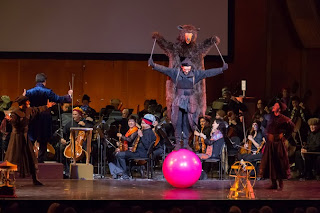


 Maestro Gilbert exiting the auditorium with a life-sized ragdoll representation of the lead dancer. It was an oddball program that brought the audience to its feet and made them feel a part of all of the musical and theatrical high jinx!
Audiences nationwide and around the world will have an opportunity to witness this genre-bending season finale concert when it is broadcast to select movie theaters in September. Check local listings for times and tickets or visit nyphil.org.
NEW YORK--Everyone got into the act, including orchestra members, conductor and Music Director Alan Gilbert and the audience in A Dancer's Dream, presented by the New York Philharmonic June 27-29. Set to two works by Russia's Igor Stravinsky (Le Baiser de la fee' (The Fairy's Kiss and Petrushka), and Excerpts from Neige (Snow) for Piano, Four-Hands from France's Louis Durey. The concert was the finale to the New York Philharmonic's regular subscription season.
Designed and Directed by Doug Fitch (Le Grand Macabre, The Cunning Little Vixen, both for New York Philharmonic, the all-encompassing production filled the Avery Fisher Hall stage with dancers, costumed orchestra members, puppets, miniatures and onstage "things," special lighting, video systems and technicians with hand-held video cameras. Whew! Even a costumed Maestrio Gilbert got into an act, standing down from the podium at points to become at first, a sort of mime and then a virtual Svengali, commanding both the orchestra and the audience with mock magical powers.
Principal Dancer Sara Mearns of New York City Ballet, danced the part of the heroine, playing first a child, seemingly overwhelmed by the mountainous winter wonderland that engulfed her, and then as a dancing rag doll in Petrushka, joined by Amar Ramasar, also of City Ballet, who doubled as a Puppeteer. Both were in their New York Philharmonic debut.
At times humorous, with orchestra members, Gilbert and the audience, joining in the fun, the concert also featured some spectacular elements of both classical and acrobat dance by an athletic Mearns and Ramasar combined with some neatly projected dramatic touches, particularly in the early scenes, in which she conveyed an Alice in Wonderland type of childish rapture. The scenery onstage was projected on a giant screen to give the eerie impression of an outsized character (Mearns) looking quizzically over the miniaturized mountainscape.
Neige gave full rein to Mearns' considerable dancing prowess, ending with her being dressed like a doll, which sequed perfectly into the final piece, Stravinsky's Petrushka. which featured a cacaphony of puppets, film, live and recorded video, placards and orchestra members in costume playing musical chairs while performing Stravinsky's dizzying music. It all climaxed with the audience letting out a previously orchestrated "Scream!" followed by


Audiences nationwide and around the world will have an opportunity to witness this genre-bending season finale concert when it is broadcast to select movie theaters in September. Check local listings for times and tickets or visit nyphil.org.
ABT's Sylvia Showcases Dazzling Principal Dancers, Delibes' Timeless Score
Reviewed by Dwight Casimere June 24, 2013
Photo: Gillian Murphy as Sylvia-by Marty Sohl

Next production: Sleeping Beauty, now through Saturday, July 6
NEW YORK--American Ballet Theatre's Sylvia at the Metropolitan Opera House, is a stylish, steamy recreation of Frederick Ashton's brilliant production, which saw its World Premiere at the Royal Opera House, Covent Garden in 2004. It is full-scale classic ballet in every since of the word, with enchanting music by French composer Leo Delibes, best known for his Opera Cpmiques Le Roi l' a dit (1873) and Lakme (1883), Original Designs by Robin and Christopher Ironside (Sylvia for Sadler's Wells Ballet in 1952) and Additional Designs for the Revival by Peter Farmer and Lighting by Mark Jonathan(Cindarella-Royal Ballet, Sylvia-Royal Opera House). With Principal Dancers in the persons of svelte South Carolina beauty Gillian Murphy and fiery Brazilian Marcelo Gomes dancing the title roles, well, how can you miss?
The partnering between Murphy and Gomes was sublime. With her high kicks and deep back bends, Murphy was a marvel to behold. Gome's effortless lifts seemed to defy gravity. His leaps suspended him in air for such an interminable amount of time, that one looked for the invisible guy wires. Among the delights of the opening act were the nimble Hunt attendants with their precision moves and a motionless Daniil Simkin as the classic god Eros, who suddenly sprang to life like one of those robotic performers in front of Ripley's in Times Square. Simone Messmer and Thomas Forster, dancing Apollo and Terpsichore were the fitting accent ague to the evening.
The colorful costumes and tightly woven ensemble dancing by the Peasants added to the sense of pageantry and sweeping drama. Orion's concubines added a fitting sultry note to the scene. Conductor David LaMarche and the orchestra made Delibe's timeless score seem vibrant and alive, as if it were composed yesterday.
The rest of the evening was full of enthusiastic dancing to Delibe's time-honored score, with Murphy giving a master class in the solo numbers that were part of the repertoire of every budding ballerina in the audience. For many, the complex footwork and sense of total ease of movement of Murphy in the famous pizzicato solo in Act III was the real standout showpiece of the entire performance. Delibe's familiar theme must have brought back memories to anyone who ever took ballet lessons and prompted thoughts of "why couldn't I have done it like that!?" Murphy was superb with her deep back bends, pliant torso twists and intricate footwork. She danced with a sense of freedom and abandonment that was exhilarating. Ms. Murphy was splendid!
ABT's Metropolitan Opera House season draws to a close this weekend with performances of Sleeping Beauty through Saturday, July 6. It's a rare opportunity to see one of the great ballet companies in the world, whose celestial array of international dancers is the envy of any touring ensemble. For those who relish the sheer joy of dancing and Tchaikovsky's enchanting music, watching ABT this weekend is an experience to rival Fourth of July fireworks.
Tuesday, July 2, 2013
Alvin Ailey American Dance Theatre is Reborn in Lincoln Center Revival
Reviewed by Dwight Casimere June 12-16 at Lincoln Center
Alvin Ailey American Dance Theatre Company photos by Christopher Duggan and Paul Kornik
pictured: Alvin Ailey's Revelations
Artistic Director Robert Battle address the audience onstage on Opening Night
Celebrity Chef Marcus Samuelsson of Red Rooster Harlem with Ailey Board Members Jufdith Byrd and David E. Monn
NEW YORK--There was a celebratory mood as Alvin Ailey American Dance Theatre held a seven- performance, five day engagement at Lincoln Center, its first in that eponymous arts center in more than a decade. The venue has particular significance, not only to Ailey fans, but to the organization's new artistic director, Robert Battle, who first laid eyes upon its grand facades and plaza as a student at the Julliard School. "I know this is our first time in Lincoln Center in a while, but C'mon!" Battle gently chided the crowd, who were perhaps overwhelmed by the grand surroundings. It wasn't long before they broke out in foot-stomping, shouts and applause as the company members pranced on stage to the Afro-centric rhythms and moves of Jamaican-born choreographer Garth Fagan's electrifying From Before, a pastiche of African polyrhythms, Caribbean dance, precision ballet and street hip hop that set the audience on its collective ear. The Ailey Company premiere is the first time this dizzying work from the Tony Award winning choreographer for The Lion King has ever been performed by a company other than Garth Fagan Dance. The fluid, acrobatic movements of the dancers was mesmerizing. At times, the repetitious movements took on an hypnotic characteristic, which, at times seemed monotonous to the untrained eye. To those familiar with the well-spring of Caribbean and African tradition from which mark Fagan's oeuvre', the repetitive nature of the dance is a vital part of its almost ritualistic roots in Afro-Caribbean tradition and culture. The jazzy percusive score by Trinidadian Grammy winner Ralph MacDonald and colorful costumes by the choreographer himself and Original Lighting by C.T. Oakes made for a perfect eye-popping opening statement for the evening and painted a clear picture of the company's new direction and renewed vitality under Mr. Battle. Now in his second season as Artistic Director, he has stepped from beneath the long shadows of founder, Alvin Ailey and Artistic Director Emerita, Judith Jamison, to give the company his own unique stamp.
The kinetic energy of dancer Yannick Lebrun filled the stage in Takademe, choreographed by Mr. Battle with propulsive electronic music by Sheila Chandra. One of his first creations, Mr. Battle's Takademe combines the taut rhythms and deconstructed moves of Indian Kathank dance with the fast-paced polyrhythms of Chandra's New Age jazz score. The music is layered with vocalized symbols that at times mimic the 'click' songs of the Tsosa tribe of South Africa. Lebrun's quick, almost superhuman leaps, thrusts and acrobatic flips were almost exhaustive to behold. The sheer dynamic of his scissoring jumps, torso contractions and deep-bending stomps occurred in such rapid succession that it was difficult for the mind to assimilate them as quickly as the eye could see them. Grace, Ronald K. Brown's landmark creation for the company in 1999 was brought back in a dazzling new production that show the best of what the 'new' Alvin Ailey American Dance Theatre is all about. Combining West African dance idioms with elements of Afro-Pop and modern dance, the work began with Duke Ellington's classic Come Sunday, followed by Roy Davis's Gospel hit Gabriel concluding with Fela Kuti's James Brown-inspired Afro-Pop music. Grace promotes the very contemporary idea, through motion, that we are all somehow touched by spiritual grace and the healing power and reach of the soul as we travail through the various ups and downs of our day to day lives. Revelations, which ended every performance during the five-evening run, is a loving tribute to the company's founder, Alvin Ailey. Created by Ailey in 1960 to spotlight the illustrious dancing of the company's principal dancer and now Artistic Director Emerita Judith Jamison, it is at once a recreation of a landmark event in the world of modern dance and a touchtone to what is a living memorial to Mr. Ailey and his vision. Set against recordings of Traditional Black Church music, Ailey's masterpiece was intended to give the audience a glimpse into his remembrances of the Baptist Church services attended as a child in rural Texas. Infused with the soul-stirring emotions of youthful religious fervor and later superimposed with the writings of African American authors James Baldwin and Langston Hughes and even later influences of Brueghal paintings and Oriental Theatre, Revelations still has the power to inspire. An elderly woman seated next to me, accompanied by her daughter, was moved to tears, as were many others. Youngsters, who had been brought to the performance by their parents, seemed transfixed by its power and majesty.
Other notable works from the long weekend's performances included Four Corners,a World Premiere by celebrated choreographer and Ailey favorite Ronald K. Brown and Petit Mort, a really superb example of the company's mastery of classic ballet forms and the technical prowess and almost overwhelming sensuality of Alvin Ailey's unique brand of dance technique. Petit Mort, choreographed by renowned European dance master Jiri Kylian and set against the music of Woflgang Amadeus Mozart's two most popular piano concertoes, really showcases the company's towering capabilities and showed why the Alvin Ailey American Dance Theatre is one of the most in-demand companies performing today. The company is celebrated globally and is designated "A vital American cultural ambassador to the world" by a 2008 U.S. Congressional resolution. This summer, the company prepares for a fall tour of Brazil and Argentina and will be conducting numerous education and performance programs at its world headquarters at the Joan Weill Center for Dance in Manhattan, the city's largest building solely dedicated to dance. The building, designed by Bibliowicz Architects, is home to The Company as well as Ailey II, which performs in the Chicago area Friday, October 25 in two performances at Governors State University at The Center for Performing Arts in south suburban University Park, Illinois. For advance tickets and information, visit alvinailey.org or call 708-235-2222. Also this summer, The Company will operate AileyCamp, a unique program that combines dance classes with personal development workshops, creative communications classes and field trips for under-served youth aged 11-14 in cities such as Atlanta, Miami, FL, Berkeley/Oakland, California, Kansas City, KS and MO Bridgeport, CT and New York City. In addition the company will be hosting world-wide auditions at its headquarters in New York and in Bari, Italy in the Puglia region. The Ailey School continues, educating more than 5,000 students of all ages throughout the year with Arts in Education and Community Programs being simultaneously held by The Ailey Organization in classrooms and community centers, bringing dance into the lives of more than 100,000 people of diverse backgrounds around the country and around the world. This was the vision of Alvin Ailey, born January 5, 1931 in Rogers, Texas. He founded the company in 1958 with the idea of enriching American modern dance heritage with the uniqueness of the African-American cultural experience. His untimely death in 1989, did nothing to dim that vision. As evidenced at Lincoln Center, it lives on in the dancers who are the apostles to


 his cultural movement and in the souls of audience members who witness his genius onstage.


Subscribe to:
Posts (Atom)