Tuesday, October 22, 2013

"All Is Lost" a triumph of cinematic, acting artistry

Robert Redford gives Oscar-worthy performance in "All Is Lost"

Reviewed by Dwight Casimere at the New York Film Festival
News conference photos by Dwight Casimere


NEW YORK---"All is Lost," starring Robert Redford, is a tribute to the art of filmmaking and the crowning achievement in an acting career that spans more than four decades. The Lionsgate and Roadside Attractions feature opened in New York and Los Angeles this past weekend and rolls out in limited release across the country next week.

Beginning with a somber monologue, spoken by Redford in a poignant internal voice and save for a desperate May Day call over a failing ship to shore radio and a few expletives shouted in frustration, these are the only lines spoken by Redford throughout the entire film.  His opening words are somewhat of an epitaph, foretelling the desperate battle for survival of man against an unforgiving sea that will unfold. A loud thump in the dark and the opening image of a giant shipping container piercing the fiberglass hull of his sailing vessel drifting in the middle of the ocean sets up the dilemma faced by the unnamed protagonist played with silent resolve by Redford. Only an actor with his cumulative skill could have executed this role with such clarity and elegance.

At 76 years old, Redford still projects the steely masculinity and understated strength that have been the hallmarks of his career. Director Chandor affirms that all of the stunts, save for one particularly dangerous underwater swimming scene, were done by the actor himself. "Bob is an avid swimmer, and in top physical condition," Chandor affirmed, with the bespectacled superstar sitting beside him wearing his characteristic cowboy boots. "We used a stunt man in that sequence, but frankly, we were even concerned about his safety because of the difficulty and danger involved." We see Redford repairing the damaged hull with epoxy and tarp and climb up the mast with the help of the bosun's chair (a task this former avid sailor can firmly attest to as a real test of upper-body strength) as he affixes the storm sail and attempts to repair his navigation and ship to shore radio connections. His electronic gear quickly gives out, an he is reduced to dusting off a previously unused ship's sextant to find his way to the nearest shipping lane where, hopefully a large container vessel, the ironic cause of his predicament, can become his salvation.

Without so much as a single word, Redford conveys both the magnitude of the danger he faces while at the same time displaying grace under pressure. His movements are purposeful, measured and deliberate. There's not a wasted motion as he sets about tightening the ship against the elements closing in around. He's completely in control, even though all is falling apart around him. We even see him cook himself a hot meal in the ship's galley, the only telltale admission that things may not be going so smoothly is the hearty extra swig of whiskey he takes to wash what may be his last meal down. Mysteriously, he even shaves, as the boat rocks precariously in the wake of the approaching storm that could wipe him out.

"We were trying to show the thinking that in the midst of a crisis like this, you attempt to do things as normally as possible," Redford said of his character's motivation. "You try to maintain as normal a routine as possible, even in the face of disaster. That's the only way you can hopefully survive mentally in that situation."

We learn little about the character he plays. In the credits, he is only described as "Our Man." We assume that he is married and has a family, because of the tone of the farewell letter he composed mentally at the outset of the film and the wedding ring we see him wearing as he outfits his boat, and later his life raft. Only as he sadly watches his vessel sink into the murky depths and we see her name, the Virginia Jane, so we get any additional clues as to his backstory.

"All Is Lost" is a masterpiece of superb filmmaking. Director of photography Frank G. DeMarco, captures the vast grandeur of the open sea, while at the same time conveying its unrelenting treachery. Underwater director of photography Peter Zuccarini, provided sequences that heightened the dramatic pace. Edited by Pete Beaudreau with spare, emotive music by Alex Ebert and production design by John P. Goldsmith,  the film has polish with a seamless look of integrity. The film takes us into the very hold of the crippled ship and brings us directly into the face of the unfolding tragedy and that of one of the finest actor's of the past century. Redford won an Oscar in 1980 for Best Director of "Ordinary People." It's high time that he is similarly recognized for what may be the crowning achievement of his career as an actor.


Tuesday, October 15, 2013

Dual debuts give New York Philharmonic concert a youthful air

Reviewed by Dwight Casimere October 15, 2013

New York-The tone was decidedly youthful with the New York Philharmonic subscription debut of one of the orchestra's assistant conductors, 26 year old Joshua Weilerstein and the New York Philharmonic debut of 31 year old German violinist Arabella Steinbacher in a program of Mendelssohn's Concerto in E minor for Violin and Orchestra, Osvaldo Golijov's Last Round, concluding with Dvorak's Symphony No. 8 in G major.

Weilerstein made it quite evident that he well knows the ins and outs of the New York Philharmonic orchestra, digging into the Latin jazz elements of the Argentine-born composer's vibrant composition with its flashes of tonal color and undulating rhythms. Weilerstein at times seemed to dance on the podium as he accentuated the compositions urgent twists and turns through the evolution of the tango. Last Round is a virtual tribute to the tango, tracing its roots from the old style in the slums to the avant garde. 

Mendelssohn's Violin Concerto is a very different story, by contrast. It is one of the most refined examples of his skill as a composer and his tremendous propensity to edit and refine his already pristine compositions to a fine, honed edge. The ravishing Arabella Steinbacher was more than up to the task of scaling the difficult technical heights of the composer's lofty vision, dispatching the most difficult passages with easy   and through the nimbleness of her supple fingers, embuing the most challenging passages with a depth of emotion that far surpassed her years. Weilerstein and the orchestra were the perfect foils for her exceptional efforts, providing the urgent underpinnings inherent in Mendelssohn's dense, but lovely orchestrations. The Andante was dripping with emotion without being overly syrupy, with Steinbacher lending an almost vocalese effect to her singing violin. The Allegro molto vivace was spine-tingling in its execution, prompting a thunderous standing ovation.

Similarly, Weilerstein led the orchestra in a vivid realization of Dvorak's Sympbony No. 8 in G Major. The bright, crisp entrances by the brass and firm, driving pulsations from the percussion made this a dramatic tour de force between conductor and orchestra. Weilerstein accentuated the composer's bright notations for the brilliant beginning Allegro con brio. The finale Allegro ma non troppo was unhurried, yet filled with energy. Levels were sustained to a near fever pitch, yet the conductor was able to hold just enough in reserve to deliver an explosive conclusion that brought down the house. Thrilling!
 New York Philharmonic Assistant Conductor Joshua Weilerstein

 German violin virtuoso Arabella Steinbacher

12 Years a Slave-Steve McQueen's masterpiece has U.S. Premiere at New York Film Festival

Fox Searchlight film opens everywhere October 18
12 Years a Slave based on the real-life account of Solomon Northup-a free black man living in upstate New York in pre-Civil War America

Reviewed by Dwight Casimere
news conference photos by Dwight Casimere

NEW YORK-Fox Searchlight film's 12 Years a Slave is Steve McQueen's gripping retelling of the true story of Solomon Northup, who wrote a book about his 12 year odyssey from being a free man, living a middle class life in upstate New York, to being kidnapped and sold into slavery. Northup's  memoir was published to great fanfare and became a best seller just eight years before the start of the Civil War.  Now, 160 years later, his harrowing tale hits the big screen in a brilliantly imagined production by one of the world's most daring directors. British director Steve McQueen is best known for his stunning work in the stark film Hunger, which depicted hunger the strike-until-death by IRA activists in Northern Ireland. African actor Chiwete Ejiofor (Talk To Me) plays the role of Northup in a heart-rendering performance and Michael Fassbender, who played the sex-addicted misanthrope in McQueen's Shame, which premiered at the New York festival two years ago, plays Northup's sadistic, psychologically twisted owner and Brad Pitt, also one of the film's producers,  makes a cameo appearance as the Canadian abolitionist who befriends him and later hands him the key that will allow Northup passage back to his old life. Henry Louis gates, the renowned African American scholar, geneologist and author, served as consultant to the film.

Written by John Ridley (Red Tails), the film begins with Northup leading the ideal upper middle class life, playing his beloved antique violin after a hard,but fruitful day working at a resort hotel in Saratoga Springs, tucking his picture perfect son and daughter into bed, and making love to his beautiful wife in their silk and satin sheeted canopy bed. When Northup's wife heads off to work for several weeks for a wealthy white family some distance away, he is wiled away by some shysters posing as agents or a traveling circus who enlist his services as a violinist for a private show in Washington, D.C. "It's only for two weeks time," the one top hatted demon in disguise promises, "after which time you'll be whisked right back home." Northup takes the offer, thinking that not even his wife will be the wiser as he'll run off, make some quick cash, have an adventure and return home without her even knowing.

After drinking too much spiked wine at a formal celebratory dinner with the two hooligans, Northup finds himself awakening from a drunken stuper in the dungeon of Williams' Slave Pen off Seventh Street n the Nation's Capital, just within sight, as the camera deftly shows, of the U.S. Capitol Building.

The film is full of such cruel ironies. Northup is lent out to a neighboring plantation by his cruel owner, whose plantation, almost Biblically, is nearly wiped out by a plague of locusts. Northup's temporary owner is a kindly judge who takes a liking to him, even going out of his way to locate a violin for him to play. Northup etches the names of his wife and children next to its chin rest. This idyllic interlude ends quickly, however, and its back to the chaingang-like existence at Bayou Boeuf, Louisiana with its endless cotton fields and hideous swamps on Edward Epps' plantation,  from which no slave ever escaped with his life.

Along  the way, Northup is given some sage advice from one of his fellow formerly-free captives, "don't let them know you can read or write. Just keep your head down, keep your mouth shut and do what they tell you."

Northup befriends one of the slave girls who becomes the unwilling paramour of the slave master, who forces himself upon her in sadistic fashion. "The scene, as horrible as it was, was actually beautiful, in the way it was shot and the way it appears on the screen. You see this silhouette, which looks almost like one of those paintings, with the stark outline of her face, with its African features, and his profile, which is so distinctly Caucasian. It's a striking contrast that reflects the dichotomy of the tone throughout the film.

"In many ways, the story of Solomon Northup has almost a Grimm Fairy Tale quality about it. Here we have this protagonist  snatched from this idyllic world and thrown into this distorted and horrible alternate reality. It's almost like Alice In Wonderland seduced by the Mad Hatter and then thrown down the rabbit hole into this surreal distorted world, which for him, was slavery on this plantation. There are so many layers of reality colliding with this surreal experience that he can't even begin to come to grips with, based on the genteel life he'd become accustomed to."

12 Years a Slave opens everywhere October 18. It is a film that commands your immediate attention.
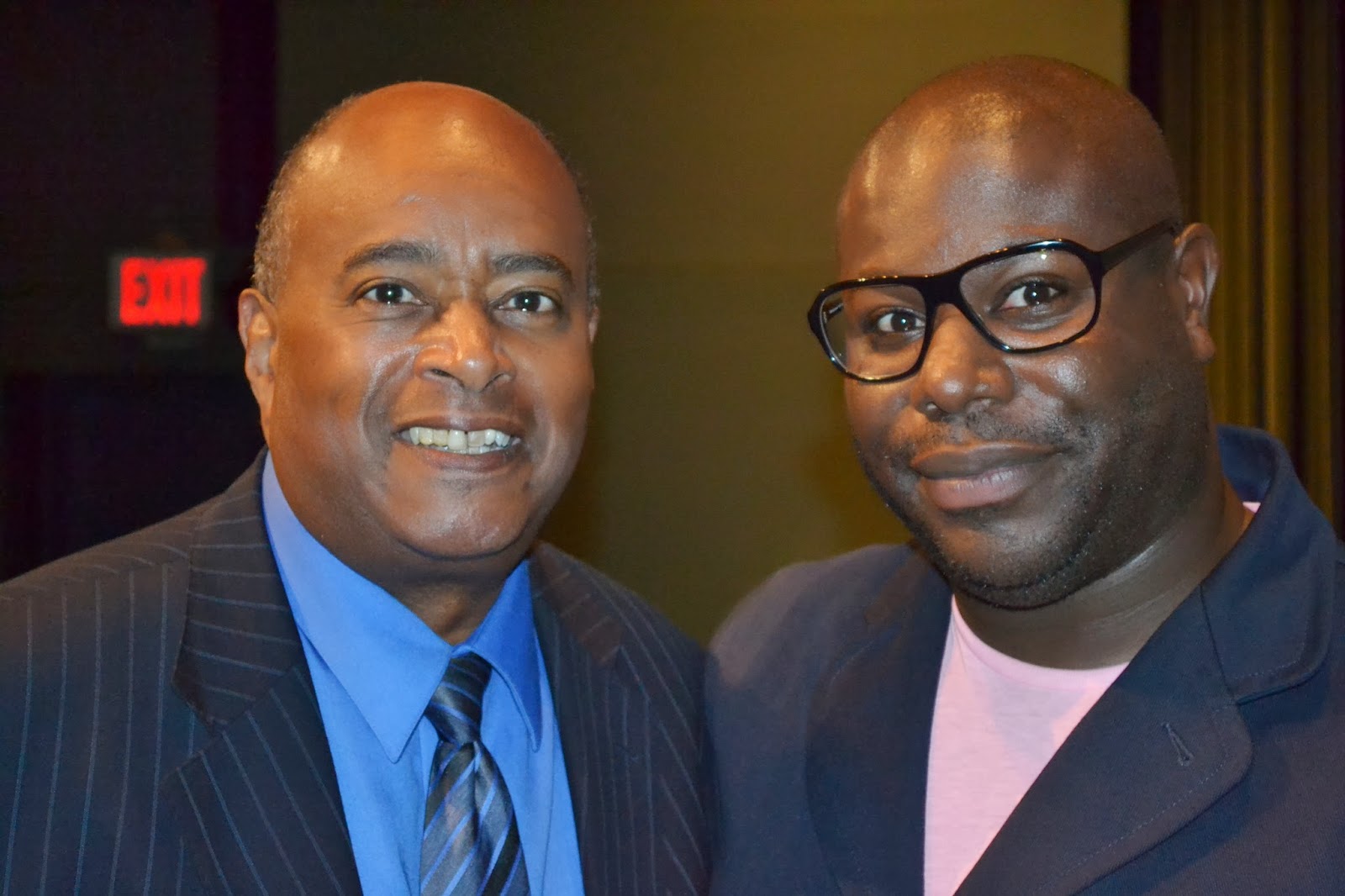
 Dwight Casimere with director Steve McQueen at the New York Film Festival
 British director Steve McQueen address the media at the 51st New York Film Festival

New York Film Festival Opens with Tom Hank's Captain Phillips

Director Paul Greengrass examines the 2009 hiiacking of a U.S. container ship by Somali pirates

Review and photos by Dwght Casimere


NEW YORK--Captain Phillips is director  Paul Greengrass's gripping account of the 2009 hijacking of the U.S. container ship Maersk Alabama by a rag-tag crew of Somali pirates. Tom Hanks is in the titled role as Captain Richard Phillips and accomplishes another Oscar worthy performance. The first actor in 50 years to be awarded back-to-back Best Actor Academy Awards (Philadelphia-1993, Forrest Gump-1994), his portrayal is already garnering Oscar buzz. Director Paul Greengrass is already known for his pulse-quickening work in such feature films as The Bourne Supremacy and Bloody Sunday. He earned an Academy Award nomination for Best Director and a Best Original Screenplay nomination from the Writers Guild of America for his work on United 93, another fact-based action thriller on the heroic deeds of passengers during the downing of a commercial jet by Islamic terrorists on 9/11.
 Captain Phillips co-star Barkhad Abdi of Somalia
Dwight Casimere with Barkhad Abdi who played the Somali pirate captain in Captain Phillips
Captain Phillips star Tom Hanks with co-star Barkhad Abdi and director Paul Greengrass


There are no soft-shaded dissolves or swelling orchestral interludes in Greengrass's heart-pounding accounting of the hijacking. Instead, the camera hones in on the central characters and follows them in an almost documentary style, allowing the action to unfold with an unblinking eye. The score, as it were, almost mimics the mechanically rhythmic and unrelenting pounding of the massive ship's own engines. Everything about the film breathes authenticity, from the script, written by Billy Ray (Shattered Glass) based on Captain Richard Phillip's own personal rendering of the events in his book "A Captain's Day," to the use of the actual Navy ships, personnel and helicopters, including the USS Halyburton, which was the ship used in the 2009 rescue mission. Captain Richard Phillips was present at the New York Premiere and walked the Red Carpet along with Tom Hanks, Barkhad Abdi and Paul Greengrass. (According to media reports, one of the Navy Seals who was part of the mission and who reportedly made a cameo appearance in the film, slipped into the New York Premiere undetected by the phalanx of media on the Red Carpet.)
Reality was the name of the game in the filming of Captain Phillip. Maersk provided a merchant vessel that was almost identical to the Maersk Alabama, the Alexander. Her crew of 22 merchant mariners remained on board during the two and a half months of filming to man the ship. The Navy provided the USS Truxton, an almost identical match, to stand in for the 510-foot-long guided missile destroyer USS Bainbridge that was actually used in the rescue operation. Real life officers and sailors served on the ship along with two sailors who actually participated in the 2009 rescue mission. A civilian SEAL advisor secured the services of ten former SEALD to take the roles of the men who carried out the close-in sniper operation. 

At the news conference following the press screening of Captain Phillips on the day of the premiere, 
Greengrass elucidated. "The entire film was shot at sea with the full cooperation and support of the US Navy. In fact, they insisted upon being involved. So everything you see in the film is real, including the scene where the pirates board the ship. That was not CG. In fact, that was one of the most difficult and dangerous scenes to shoot."
In the movie, pirates board the huge Maersk Alabama climbing ladders from a tiny makeshift skiff, that looks more like the boats used by soon-to-be-drowning refugees than a band of professional outlaws.
"We went through weeks of rigorous training," said Abdi, a first-time film actor, who had the daunting task of matching wits standing toe-to-toe with arguably one of the best actors in the world. "The whole thing was frightening, especially because I can't swim. I also had to learn to climb. I should have been scared, but that wasn't an option, when you're clinging to a flimsy ladder 100 feet above the surging water, the only thought you have is "I have to get to the top of that ship!"

Greengrass humanizes the Somali pirates, rather than painting them as one dimensional villains. He takes us almost immediately to the Somali village where they are almost forced into criminal action by a band of Uzi-wielding warlords. The pirate skiffs are a way out of the grinding poverty of the village where the inhabitants, including the pirates, eat a constant diet of khat, an hallucinogenic plant which also, conveniently, suppresses the appetite in a land where food is scarse. The pirates can be seen stuffing their razor-thin cheeks with the substance. Things start to unravel go haywire when they run out of their dietary and psychological crutch.

Moving the ships around in surging waters also proved to be a daunting and dangerous task. "The sea can be calm one minute and then erupt into giant swells the next.  Getting all of the ships and the helicopter and the rescue team in position for the final rescue scene was a monumental logistical endeavor. Not to mention the job of maneuvering the five hundred foot container ship."

Not only were the most dramatic scenes filmed in realistic fashion, the final scene, where Captain Phillips was brought onboard the rescue ship and taken to the ship's infirmary and examined by Navy medical personnel, was filmed in the actual infirmary where the event occured and, by happenstance, with members of the medical team who attended the real Captain Phillips in 2009.  "We were taking a tour of the ship to see where we might shoot some interior scenes. We had tried to shoot the final scene elsewhere, but it just didn't seem to work out. When we went below decks and walked through the infirmary, we learned that the Navy personnel on duty that day, including the captain in charge of the medical team, were the same people who had attended top Captain Phillips in 2009. We decided right then and there to set up lights and shoot the final scene there. After the medical staff got over the initial jitters of being on camera, it went smoothly. It turned out to be one of the most moving  scenes in the film because it had the ring of truth. That's the most important thing about the entire film is that all of the actors and the crew strove to find the truth in every situation depicted in the film." 

Tuesday, September 17, 2013

51st New York Film Festival to open September 27

Frederick Wiseman's new film "At Berekely" 
Reviewed by Dwight Casimere, September 16, 2013

 Filmmaker Frederick Wiseman

A scene from "At Berkeley"


NEW YORK--Veteran documentary filmmaker Frederick Wiseman shines again in another unflinching look at one of America's most controversial and celebrated institutions in his new "At Berkeley" (2013), which will be presented at the 51st New York Film Festival on Saturday, September 28 at 4:30pm in the Walter Reede Theatre, Lincoln Center, with a live Q & A with the filmmaker present, following the film. Clicking in at a exhaustive four hours and four minutes, the film takes an kalaidoscopic look at the inner workings of the university from the multiple viewpoints of faculty, students, administrators, and even maintenance workers and the owners of nearby shops and restaurants and other service providers whose businesses are intertwined with that of the university.  Wiseman's work is best described as "oberservational," with the camera recording often mind-numbing events, such as staff meetings and roundtable discussions, without so much as a line of off-camera narration or any subtitles or identifying supers. Wiseman, now 83 years old, and his work are the very embodiment of the concept recognized today as "reality tv," with his body of fllm work which began in 1963 with probing examinations of social institutions (Hospital-1977, High School-1968, High School II-1994). His film "Law & Order," which examines police work from the inside out, was light years ahead of the likewise named Tv franchise, decades before its inception.

 Trained at Yale Law School and a law professor at Boston University College of Law before embarking on a career as a filmmaker, Wiseman takes no sides, nor does he take any prisoners. Winner of the Peabody Award and both the Guggenheim and MacArthur Fellowships,  "At Berkeley" stands now as his best work and a culmination of the refinement of his art. Particularly telling are two scenes; one depicting a meeting of administrators crafting new school policies which are met with dissatisfaction and, eventually, protests by the student body. One of the administrators offered that he was a student at Berkeley and was an active participant in the ground-shattering Free Speech Movement. One of the catch phrases of the student movement was "Do Not Fold, Bend or Staple Me," which referred to the inscription on computer programming cards of the then IBM computer systems used at the school. He offered that the feeling of institutionalization by the students still persists today, with decisions being made for them, without their involvement at the decision-making level. In short, very little has changed and the university is folding back  on itself and the time-warp continuum, facing the same challenges of self-determination by students and the conflict with top-down management tactics by the university. Another gripping moment was the exchange of a bi-racial black and hispanic student with her white counterparts who questioned their sincerity in raising the issue of white students who are now finding themselves financially challenged by newly created impoverishment due to the ongoing recession. "Why should I be concerned about your new interest in poverty and your inability to get student aid when I've been suffering as have other minority students for decades and noone cared about me and my poverty then?" The discomfort in the room is both visual and palpable. Wiseman's film is a long sit, but its guaranteed that not one person will walk out on it as it bores deeper into the soul of the type of discomforting issues faced, not only by the university, but by corporations and governmental bodies everywhere.

Wednesday, August 7, 2013

Flashdance The Musical Celebrates 30th Anniversary of Academy Award-winning film with national tour

Special to Dwight The Connoisseur

FLASHDANCE-THE MUSICAL,  the stage adaptation of the 1983 Academy Award winning film that starred Chicago/Hyde Park native Jennifer Beals, is making a final stop in Chicago before a second company begins an open-ended engagement on Broadway, to celebrate the Paramount Pictures film's 30th anniversary. The Chicago engagement is for a lmited two week run through August 18, 2013. The touring company continues, opening in Memphis September 17 and Indianapolis October 1.

A stellar cast, with strong singing voices, electrifying dance moves and explosive multi-media sets and lighting, made this Broadway In Chicago presentation one of the most seamlessly polished offerings of the season.

FLASHDANCE tells the story of spunky Alex Owens (a mesmerizing Jillian Mueller), one of the few, if only female welders at a Pittsburgh steel mill, who is also an exotic bar dancer by night. With dreams of hitting the big time as a legitimate stage dancer and attending the prestigious Shipley Dance School, she butts heads and eventually falls in love with the boss's son, Nick Hurley (a sylvan voiced Matthew Hydzik), who tries, against stubborn Alex's wishes, to use his influence to help her get an audition at the dance school, and who also wrestles with the moral challenges of being the heir apparent in a family business that he has no desire to enter.

The dancing is stupendous, among some of the best on any Broadway stage and the characters are well drawn and leap off the stage to grab the audience by the heartstrings.  All of the hit songs and dance numbers from the film are presented with panache and sung with a verve and enthusiasm that makes it seem as if we're hearing them for the first time. FLASHDANCE, the original movie, won an Academy Award for the title song "Flashdance-What a Feeling" and the songs "Maniac," "Gloria,", "Manhunt," and "I Love Rock and Roll" all became Top Ten hits on the radio. The film revolutioned pop culture and grossed over a 150 million dollars, making it the third highest-grossing film of 1983. The soundtrack won the Grammy Award.

The current touring production of FLASHDANCE THE MUSICAL captures all of the original explosive energy of the film and with the use of brilliant lighting effects, imaginative costumes and craetive use of digital images and sound effects and kinetic dancing.

Some of the standout performances include Mueller, in the title role, who dazzles with some gravity defying dance moves, including the famous show-stopping shower dance scene and the highly emotive audition dance scene, in which she moves with rare abandon. She was even able to elevate some of the more talkie lines of the lengthy vocal soliloquy in the second act to a spine-tingling finale. Matthew Hydzik used his bright. flexible voice to great advantage, navigating the tricky octave jumps with ease and infusing them with an almost mystical, haunting quality that made the believability to his character even more so. DeQuina Moore as Kiki, rocked everyone's collective world with a sassy rendition of Manhunt that brought to mind the great Grace Jones.

Chameleon Girls, which opened Act Two, showed off the collective dancing and vocal skills of the slithering, acrobatic female performers and set the stage for the thrilling roller coaster ride that brought the evening to its glittering climax and thunderous applause from the appreciative audience. What A Feeling!


Saturday, August 3, 2013

Mostly Mozart at Lincon Center: Emanuel Ax in pensive, precise Beethoven Piano Concerto No. 2

 Emanuel Ax at the keyboard in the throes of rapture
Andrew Manze at the podium